Consider the bakery and branches separately.
Preparing dough at night, firing up ovens, and supplying the first branches. Then it's on to staffing, inventory, and organization. Owners and managers who also work in the business often need some sleep by midday. There's little time for in-depth price comparisons in the daily grind.
Three questions that often get overlooked in day-to-day business: When does each electricity and gas contract end? What happens when a branch closes or opens? Which meter belongs to which bakery or branch? This is understandable: your attention is focused on quality, the team, and the customers every day.
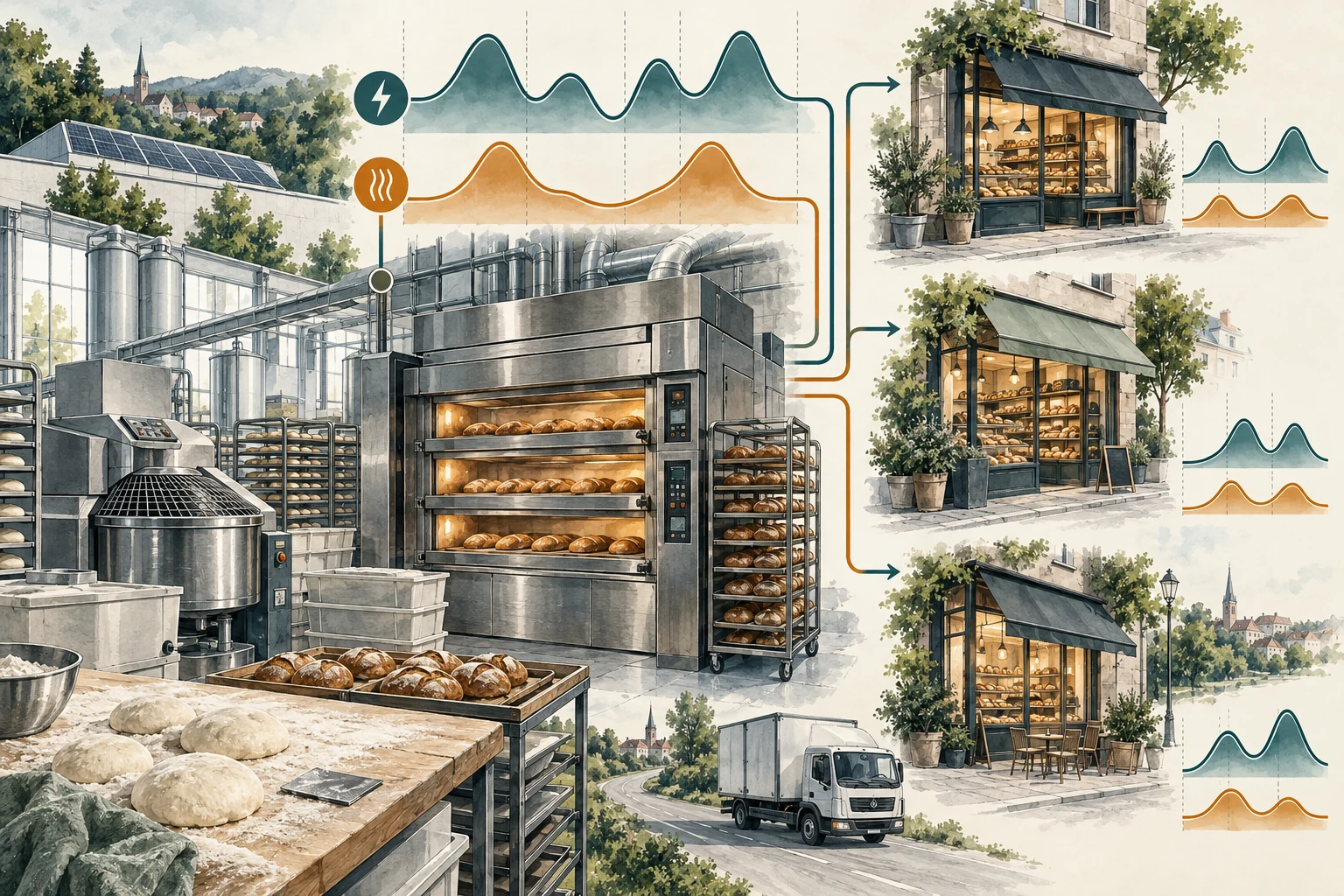
We consider the bakery and branches together, but their energy consumption separately. The crucial factor is when ovens, fermentation technology, refrigeration, and sales require energy. The Mittelstandsinitiative Energiewende und Klimaschutz also addresses these areas separately.
First, organize your business.
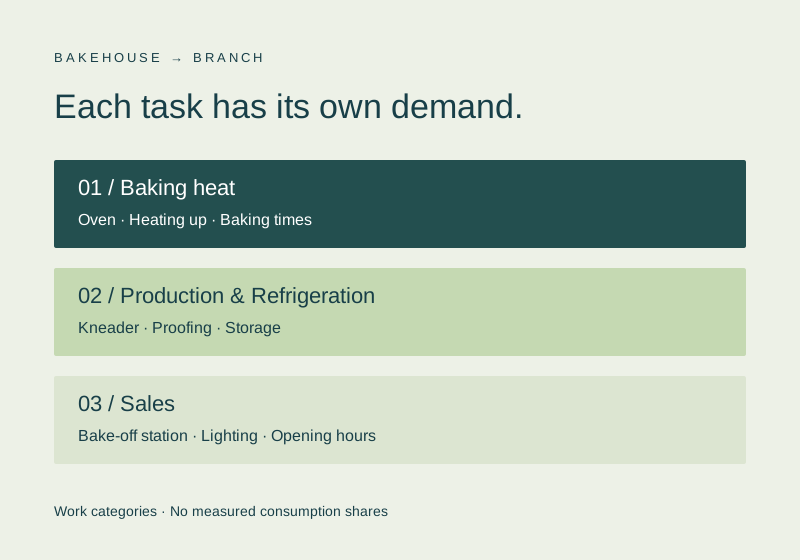
For an initial overview, three work areas per location are sufficient: baking heat, production and refrigeration, and sales. Record the actual energy source used in each area. An electric oven also falls under baking heat; its consumption may only be counted once in the total electricity consumption. With a shared meter, these are initially work categories, not measured partial consumptions. Therefore, clearly indicate which figures are actual readings and which are only estimates.
A branch with its own in-store bakery cannot simply be compared to a simple sales stand. Opening days, floor space, and product range, in addition to energy consumption, are all relevant factors. A shared location list should therefore note whether baking takes place on-site, whether products are only baked off, or whether the branch exclusively sells goods. This transforms "Branch A requires more electricity" into a verifiable question: Is it due to longer operating hours, additional equipment, or an unusual pattern?
For each bakery and branch, complete the information from the invoice and contract: market location ID, energy source, metering type (registered load metering, or RLM, or standard load profile, or SLP), supplier, contract end date, and notice period. This will show you which contracts expire first and which locations can be tendered jointly. If you bake with gas, the meter measures cubic meters. Billing is done in kilowatt-hours; the conversion is done using the gross calorific value and gas volume correction factor, which are listed on your gas bill.
Organizing multiple locations · Keeping an eye on contract deadlines · Converting gas from m³ to kWh
Compare operating times with the load profile
Place a typical production day, a reduced-hours day, and a day off side by side. Mark the start of production, heating-up, start of sales, and cleaning. A load profile shows how the power consumption changes throughout the day. If measurement data is available, the Load Profile Guide will help interpret the curve.
The start of production deserves a second look. If several electric ovens heat up together while kneaders and refrigeration systems run, the site’s highest quarter-hour power demand may occur then. With recorded load measurement (RLM), this peak may increase network charges through the demand charge, usually even with a fixed energy price. Check with your technical team whether ovens can start in stages, taking baking quality into account.
Smaller branches are usually billed using a standard load profile (SLP), generally up to around 100,000 kWh of electricity per year (one hundred thousand). A demand charge usually does not apply there, so a lower peak does not reduce the network charge. Understand peak demand and network charges · Find peaks in the load profile compass
High nighttime consumption is not automatically avoidable: cold storage rooms and freezers are cooled around the clock, and dough retarders chill dough pieces overnight before they are proofed according to a timer. A deviation only becomes noticeable in the context of the actual process. Changes to cooling or fermentation should be coordinated with those responsible for technical and hygiene aspects; food quality dictates the parameters.
Make an operating hour visible
A hypothetical example calculation: A system consumes an average of 4 kW and runs for an additional hour daily on 250 operating days. This corresponds to 4 kW × 1 h × 250 = 1,000 kWh. Assuming a variable price of €0.25/kWh, this would amount to €250 for this consumption.
The 4 kW represents assumed average power consumption during the additional hour, not necessarily the nameplate rating. The €0.25/kWh is an example value, not a current offer. Consumption only falls accordingly if the additional operating time can be removed without affecting production or cooling. Standing charges and any demand charges are excluded. Enter your own values in the electricity cost calculator.
Preparing the next energy contract
Provide us with your electricity and gas bills, current contracts, and a list of your bakeries and branches. Existing load profiles will complete the picture. We will clarify what information is missing and take into account new sales outlets, different opening hours, or a planned oven replacement. Let's talk about your bakery and branches →
You tell us how much security your business needs. We translate that into a suitable procurement solution. If you want fixed prices and minimal ongoing decision-making effort, we focus on price guarantees, appropriate quantity rules, and a reliable contractual partner. A fixed price guarantees the agreed energy price for the contractually stipulated quantity. Depending on the contract, network charges, levies, and taxes, and for gas also CO₂ costs, as well as deviations from the agreed quantity, can still affect the final bill.
If you want to take advantage of market opportunities, we also present flexible options. Before making your decision, you'll know the fixed and variable components and see scenarios illustrating how rising and falling prices can affect your costs. Greater market exposure opens up opportunities while simultaneously exposing unhedged quantities to rising prices.
Compare fixed prices and flexible models · Quantity bands and quantity increases or decreases · Understanding gas procurement for your business