
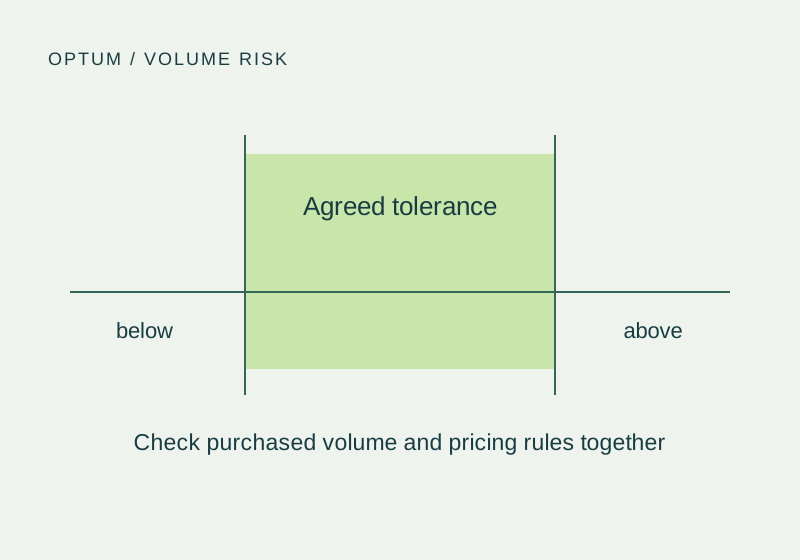
What a volume tolerance band defines
A company plans for a certain volume of electricity. Actual consumption may differ because of changed orders, new equipment or a longer shutdown. A volume tolerance band defines an agreed range around the planned volume, with a lower and an upper limit, for example. It is part of the rules governing how the supplier handles deviations. The contract terms specify whether the agreed price applies within the band and how volumes outside it are billed.
There is no volume tolerance band that automatically applies to every business offer. Some offers include tolerances, others have separate rules or a different pricing model. The term “full supply” alone also does not tell you whether higher or lower volumes are covered without extra costs. Ask the supplier to explain the financial consequences of a deviation using an example.
First, clarify the reference point.
- Period: Is the deviation assessed per year, month, or over the entire period?
- Scope: Does the quantity apply per delivery point or to the joint portfolio?
- Initial value: Is the forecast fixed or adjustable according to a defined procedure?
- Boundary: Is only the volume outside the tolerance settled separately, or a larger difference in volume?
Two percentages are comparable only if they use the same reference basis. Across multiple sites, a shared tolerance band can work differently from separate bands for each site. The offer should explain this clearly.

A volume tolerance band is unclear without its reference basis
When is a deviation determined?
Which quantities are considered together?
How are deviations settled?
A numerical example to aid understanding
Assuming the agreed annual quantity is 1,000,000 kWh, a band of ±10 percent chosen solely for explanation purposes would then range from 900,000 to 1,100,000 kWh.
- Excess consumption: At 1,150,000 kWh, 50,000 kWh are above the upper limit. However, compared to the planned amount, the excess consumption is 150,000 kWh.
- Reduced consumption: At 850,000 kWh, this is 50,000 kWh below the limit and 150,000 kWh less than planned.
The contract must clearly state which of these differences counts for billing purposes.
No surcharge or credit can be calculated based solely on the 50,000 kWh. The contractual billing formula and the relevant prices are missing.
The figures do not represent standard market tolerances or OPTUM's terms of offer. They illustrate why quantity specifications and pricing must be reviewed together. Furthermore, identical percentage limits for both upper and lower limits do not imply that over- and under-consumption will be billed using the same pricing formula.
Consider changes before finalizing the contract
An additional production line or a new charging system changes more than the annual electricity volume. Its distribution over time can also change. Check which changes are already included in the forecast and how later adjustments should be reported.
For self-generation, the remaining amount of electricity purchased is relevant. Only the solar power that the business can actually use itself can be deducted from the previous grid consumption. Surpluses fed into the grid do not replace later electricity purchases. Therefore, for accurate forecasting, generation and consumption must align in time. See also article Photovoltaics, Storage and Residual Electricity Contract .
Four answers before the decision
Have the delivery quantity, how deviations will be detected, the applicable formula, and your reporting options explained to you in writing. Additionally, ask when planned changes must be reported and whether these changes will affect prices or other terms. Document the answers along with the relevant section of the contract.
For comparison purposes, you can provide all suppliers with the same three consumption scenarios: less, as planned, and more. Ideally, the quantities should come from your operational planning. This way, you compare the economic consequences on the same basis, instead of solely determining the cheapest offer based on the price per unit.
Discuss quantity planning and procurement requirements with OPTUM: Specify the expected annual quantity and any foreseeable changes. We will clarify the framework for further bid evaluation with you.
From actual consumption to billing
- 01Determine consumption
Determine the actual quantity for the agreed period.
- 02Check the purchased quantity
Compare with the contractual forecast and tolerances.
- 03Apply price rule
Check the handling of deviations as agreed in the contract.