

Commercial gas: Gas procurement tailored to your business
Commercial gas supplies businesses with energy for heating, hot water, and operational processes. When comparing tariffs, it's therefore worthwhile to consider the entire supply period, not just the price per kilowatt-hour. Annual volume, supply profile, location, contract duration, and the rules for excess or shortfall quantities all determine whether an offer is suitable for your company.
A hotel, a bakery, and a manufacturing plant have different consumption patterns. Even with the same annual volume, seasonal distribution and short-term peak demands can vary. Therefore, a suitable procurement framework begins with your existing invoices and measurement data.
This guide explains gas for commercial and industrial users, the main price components and a structured comparison process. After reading it, you can assemble the necessary documents and identify whether two offers really cover the same service. The same supply point, delivery period and assumed volume are decisive.

What is commercial or industrial gas?
These terms primarily describe commercial use and the associated supply contracts. Commercial gas is not automatically a different gas quality than gas for households. Switching suppliers mainly affects price and contract terms; the supply continues via the local gas network.
For smaller or more consistently predictable consumption levels, supply can be managed via standardized profiles. Larger or appropriately equipped delivery points can be billed based on measured load profiles. You should refer to your contract and network documents to find out which measurement and balancing methods apply to your connection.
Distinguish between heating gas and process gas
Heating requirements often depend heavily on temperature and building usage. Process gas, for example, is used in furnaces, drying processes, and other production steps. Here, capacity utilization, shift patterns, and production planning influence consumption. A residential floor area estimate is not suitable for determining this industrial demand.
If your meter displays cubic meters but your bill shows kilowatt hours, the gas converter for m³ to kWh can help. Use the gross calorific value and volume conversion factor from your bill to ensure quantities are compared on the same basis.
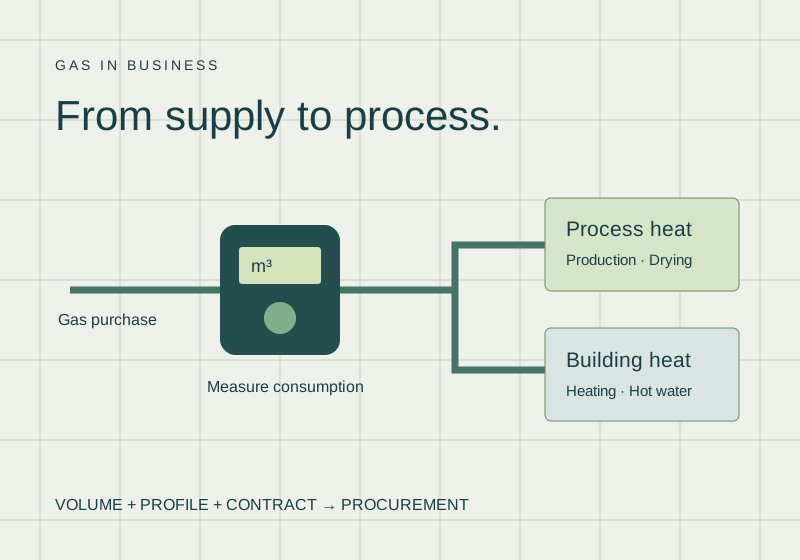
Understand gas use in your business.
- Gas procurementSupply contract and quantity profile
- Measure consumptionMeter readings and energy quantity
- Use heatProcesses and equipment in your business
Schematic representation. Demand and procurement belong together.
Record space heat and process heat separately
Record heated areas, temperature requirements and usage times.
Describe facilities, batches and shifts; demand may also arise in summer.
What does the price of a commercial gas tariff depend on?
A larger order quantity may allow for different procurement and sales terms. However, it does not guarantee a lower overall price. The timing of the contract, delivery period, location, profile, creditworthiness, and desired flexibility can significantly influence the price.
| Component | What you should pay attention to |
|---|---|
| Energy price | Fixed, index-linked, or mixed model; check the exact calculation rule. |
| Network and measurement | Consider the delivery point and metering concept; differentiate between included and separately charged fees. |
| Other fees and taxes | Compare the same price basis and validity period |
| Basic and demand charges | Include additional fixed or demand-based costs in the annual review. |
| Quantity conditions | Read the rules for excess or shortfall quantities and forecast changes. |
A price difference calculated correctly
With an annual consumption of 500,000 kWh, a difference of 0.5 ct/kWh theoretically equates to €2,500 per year: 500,000 × €0.005. This is a hypothetical example calculation. Different base prices, terms and conditions, or additional costs may affect the overall result.
Therefore, compare offers completely and on the same net or gross basis. Have any advertised price advantage calculated in euros for your annual quantity and have it shown which components are included. Be sure to check particularly low promotional prices for terms and conditions, duration, and any subsequent price changes.
For which companies is a commercial gas comparison worthwhile?
A comparison can be just as relevant for small businesses as for larger customers. Preparation is particularly worthwhile when a contract is expiring, new equipment is being added, or multiple delivery points are currently being sourced separately. Comparing your specific quantities and contract terms will reveal whether another offer is a better fit.
These documents provide a good foundation
- The last complete gas bill including delivery address and consumption period.
- The current contract including its duration, notice period, and pricing rules.
- Annual consumption in kWh and available load profile data.
- Foreseeable changes such as new facilities, additional shifts, or vacancies.
- For multiple locations, an overview of each delivery point and contract end date.
For property management companies, property allocation and the separation of supply contracts and internal cost allocation are also important. Only those services that fit together contractually, temporally, and organizationally can be bundled. This article for property and condominium owners' association management explains the preparation process.
Prepare for a contract switch
Before entering into a new contract, existing deadlines and the potential start date for deliveries should be clearly defined. Engaging a new supplier does not automatically terminate all obligations under the old contract. Therefore, for each delivery point, document when the old contract ends and the delivery start date confirmed by the new supplier. This will help you avoid conflicting dates in your planning.
Consultation and comparison of offers: make informed decisions
OPTUM EBA supports energy procurement for companies and property management firms. The starting point is your consumption and operational requirements. Based on this, suitable procurement models and comparable offers are considered.
- Clarify requirements: Combine delivery points, quantities, deadlines and changes.
- Agree on a framework: Define price guarantees, flexibility and acceptable fluctuations.
- Compare offers: Evaluate price components and contract terms on the same basis.
- Prepare implementation: Document the decision, responsibilities and next deadlines.
The specific tasks that OPTUM, your company, and the supplier will each undertake will be agreed upon in advance. This also applies to the scope of services and remuneration. A clear comparison should highlight both the advantages and limitations of each proposed option.
Prepare your conversation about gas procurement →
First, make the same assumptions, then compare prices.
- Period
Assume the same delivery start date and the same delivery period.
- Quantity
Use the same delivery points and consumption assumptions.
- Price scope
Compare the contained and variable components.
Monitor gas prices and assess procurement risks
A gas price only becomes meaningful when considered in conjunction with the market area, delivery period, and contract terms. Our article Market Monitoring with OPTUM Pro shows how we interpret such information.
Past gas prices provide context, but no guarantee for future delivery years. Weather, demand, import options, storage, and political developments can all change the market. Therefore, a single forecast should not replace a comprehensive procurement strategy.
A fixed-price model can make the agreed-upon components more predictable. A market-based model allows price changes to have a greater impact on purchasing. Hybrid models combine fixed and variable components. The crucial factors are which fluctuations the company can absorb and which quantities need to be secured early.
Even with tranches, the outcome is significantly influenced by the pre-agreed strategy and subsequent market developments. The allocation, timeframes, guidelines, and deadlines should be clear before the first purchase. An overview can be found under Spot Market and Futures Market and Procurement Strategies.
Frequently Asked Questions
Is commercial gas always cheaper than residential gas? No. Quantity and gas profile can result in different terms; an advantage only arises from concrete, fully comparable offers.
Can I estimate consumption based solely on area? For residential buildings, a simplified estimate is possible. For process gas and commercial areas, actual consumption and operating data are much more suitable.
Does the spot market chart on this website show gas prices? No. It shows day-ahead electricity prices from SMARD. These should not be interpreted as gas prices or as an offer for your business.