Spot market and futures market: What companies should know
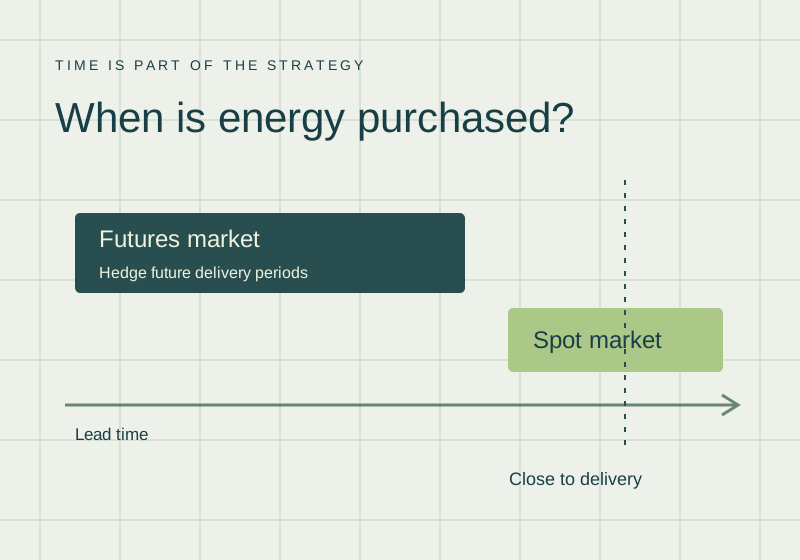
Electricity and gas can be procured on a short-term basis or for later delivery periods. The spot market focuses on immediate delivery. The futures market involves agreeing on prices and quantities for future periods. Both markets are part of energy procurement and can be combined in a single strategy.
For your business, there is more to consider than which market currently looks cheaper: How predictable is your consumption? What price fluctuations can your budget absorb? And which price components does your supply contract actually protect?
This article explains spot prices, day-ahead, intraday, futures, and forwards. The interactive SMARD chart shows published day-ahead electricity prices. It is intended to provide an overview of market activity and is not an offer for your energy contract.

Spot market electricity chart: How to correctly interpret prices and time periods
Select a market area and period in the chart. Germany/Luxembourg, Belgium, France, the Netherlands and Austria are available. The daily view shows quarter-hourly prices; longer periods show daily averages. Set the start and end of a custom period within the stored dataset.

The dashed line is the arithmetic mean of the valid values actually displayed. In the daily view, these are quarter-hourly prices; in the multi-day view, they are complete daily averages. A day is only averaged if all its quarter-hourly data is available. Gaps are neither filled nor bridged with a line. The table shows the data source for each displayed value.
All times use Europe/Berlin. At daylight saving time changes, a delivery day does not always contain 96 quarter-hour intervals. In the detailed view, CET and CEST distinguish clock times that occur twice. The date of the price data and the retrieval date appear directly above the chart; if an update fails, the last valid data remains visible.
The unit is euros per megawatt-hour: 100 €/MWh = 10 ct/kWh. This wholesale price does not automatically include the other components of your supply contract. Your personal average may also differ: If your business requires a particularly large amount of electricity during expensive periods, its consumption-weighted price will be higher compared to a simple time average.
The data comes from Bundesnetzagentur | SMARD.de. SMARD publishes quarter-hourly day-ahead prices from the delivery date of 1 October 2025. This chart excludes gas, intraday and forward and futures prices.
Spot market: Definition and delivery horizon
A spot market is a market for energy that can be delivered at short notice. Buyers and sellers agree on quantities for timely delivery intervals. The crucial factor is the short time between the trade and delivery; specific trading deadlines depend on the particular product and trading venue.
The spot market is not simply a market for surplus stock. It serves the purpose of short-term procurement, balancing changing demand, and selling available quantities. Your supplier can handle market access and purchasing for your business. The supply contract will then specify how the market price is factored into your energy price and what additional services will be charged.
Energy trading: supply, demand and procurement
The energy market is where generation, expected consumption, and transportation options converge. Weather, available power plants, storage levels, fuel prices, and grid conditions all influence pricing. Electronic trading platforms match buy and sell orders.
An energy exchange price and a delivery price are different things. The supplier must, among other things, cover the agreed consumption profile and handle deviations between forecasts and actual consumption. The services and risks the supplier assumes and how these are compensated are stipulated in the contract.
Spot market gas: procuring short-term gas volumes
The gas spot market deals with short-term gas volumes. Temperature-related heating demand, industrial demand, available imports, and storage movements can all influence prices. A short-term price is not a reliable forecast of the costs for an entire heating season.
For businesses using process heat, their own consumption profile matters especially. A seasonally affected office building needs a different procurement framework from a continuously operated production plant. Our business gas guide lists the information needed to compare offers.
Electricity spot market: distinguish day-ahead and intraday
Day-ahead
In day-ahead trading, electricity is traded for delivery intervals of the following day. The auction aggregates the bids and determines prices for the respective market areas and intervals. These published day-ahead prices form the basis of our chart.
Intraday
In intraday trading, market participants can adjust their positions closer to the delivery time, for example, if the forecast for wind power or consumption changes. Depending on the trading method, this results in different transaction or auction prices. The day-ahead curve shown does not provide information about the intraday price at which a specific quantity was traded.
The terminology should also be clear in offers. Check which index is used, what time resolution applies, and how your measured quantities are allocated to the price.
Spot market electricity price: How to correctly interpret fluctuations
Spot prices can rise, fall, and even be negative at times. However, a negative wholesale price does not automatically mean a negative overall bill. Other price components and the specific billing rules of your tariff remain crucial.
The simple arithmetic mean of a price curve gives equal weight to all displayed values. The consumption-weighted purchase price instead weights each interval by the energy you consumed during it: add up interval price × interval consumption across all intervals, then divide by total consumption. This relationship can only be calculated meaningfully using measurement data for the corresponding time intervals and the applicable contract rules.
Load shifting may therefore be relevant if your contract actually passes on time-dependent prices and your operating processes allow it. Production, quality, safety and delivery deadlines set limits. The load profile helps identify possible time windows first.
Why your own average may differ
A simplified example with two equal intervals: The market price is €50/MWh in one interval and €150/MWh in the other. The simple average is €100/MWh. However, if the business consumes 1 MWh in the cheaper interval and 3 MWh in the more expensive interval, this results in (1 × 50 + 3 × 150) ÷ 4 = €125/MWh. This example considers only the energy price. It shows why the pattern of your consumption is just as important for a spot contract as the price curve.
A market price increase can also burden suppliers if fixed customer prices meet insufficiently hedged quantities. The article Energy Prices and Supplier Risk: Understanding the Chain Reaction explains what this means for companies and their new supply.
Multiple delivery points: Combining market observation with property demand
Property management companies and businesses with several sites should first organize quantities, billing periods and contract durations separately for each supply point. Referencing the same market does not mean that every site receives the same price or contract structure.
An overview of annual volumes, metering points, contracts, and existing load profiles provides a good foundation. Based on this, companies can weigh up fixed-price contracts, a spot component, or a combination thereof. For property management companies, OPTUM aligns procurement with fixed prices and suitable portfolio processes: Many individual meters require a suitable supplier, a clear framework agreement, and reliable organization. Energy Procurement for Property and Condominium Management Companies provides further details on this process.
Futures market: agreeing on prices for future delivery periods
The futures market is where contracts are concluded for future periods. These can be, for example, monthly, quarterly, or annual products. Available delivery horizons and conditions depend on the product; there is no general fixed maximum term for the entire electricity or gas market.
Forward and futures market prices also move before a transaction is concluded. Once prices are fixed, the agreed price components can become more predictable. This does not guarantee that the deal will later be cheaper than short-term procurement. Volume deviations, variable price components and collateral still need to be considered.
| Question | Spot market | Forward market |
|---|---|---|
| Delivery horizon | Short-term intervals | Future delivery periods |
| Fixed pricing | Depending on the short-term market | Agreed components can be fixed after the contract is concluded |
| Key considerations | Market movements and budget fluctuations | Earlier hedging and later missed price declines |
Gas futures market
Gas futures contracts allow for the agreement of future volumes and prices. For heating needs, seasonal distribution can be relevant; for process gas, a different profile often applies. An annual volume alone only partially describes these differences.
Therefore, check the delivery period, quantity range, deviation policy, and price components. A low product price alone does not constitute a complete comparison if another offer includes different flexibility or risks.
Electricity futures market
Electricity futures products can hedge against future price risks. It's important to distinguish between standardized exchange-traded products and the individual supply contract for your specific location. Hedging a standard profile does not automatically and completely reflect a company's actual consumption.
An electricity future does not necessarily result in physical electricity delivery. Depending on the product specification, it may be settled financially; certain products offer physical delivery options. The applicable product terms are decisive, as described, for example, by EEX for Power Futures.
Related to this: Distinguish between price hedging and actual delivery →.
What are forward markets?
A forward is a transaction for future delivery or settlement agreed individually between parties, often concluded outside an exchange as an OTC (over-the-counter) transaction. Quantity, price, delivery period and settlement can be tailored in the contract. A forward therefore belongs to the forward and futures market.
Alongside the price, the counterparty’s creditworthiness, possible collateral and the terms for disruptions to contractual performance matter. Agreed delivery times and quantities, expected market developments and the risks assumed affect the offer. Your comparison therefore needs to consider the specific forward or futures transaction with all its terms.
What is a futures contract?
A forward or futures contract sets the terms of a transaction to be performed in the future. These include the product, quantity, price or pricing rule, period, and physical delivery or financial settlement. A contract can provide a hedge while also creating new obligations and risks.
The price hedge for your business must match its later energy offtake. For example, a standard product with a uniform year-round profile does not fit a business that only opens in summer. How the supplier handles differences in timing and volume deviations affects the full quoted price.
A contract must match the consumption profile
- Pricing rule
- Delivery period
- Volume profile
Forwards and futures: two forms of trading for future dates
Forwards and futures are two forms of transaction for future delivery or settlement. You agree on a transaction today that will be performed later. The main difference is how individually the terms are agreed and how the transactions are settled. Futures are typically standardized exchange-traded contracts with defined settlement procedures; forwards are agreed individually between parties.
Standardization facilitates comparison and trade, but it does not replace the examination of the specific product. With both forms, companies must understand which price risks are hedged and which risks remain.
Frequently asked questions about the spot market and the futures market
How much administrative work does a spot tariff require?
The supplier handles the procurement and processing as contractually agreed. On the company side, tasks such as data verification, budget monitoring, and the evaluation of price changes remain relevant. Tasks and responsibilities should be explicitly defined.
Are there risk premiums or other fees?
A spot-market model can also include supply, settlement, profile or other contractual charges. Compare the complete price structure. Exchange-linked pricing alone proves neither lower total costs nor the absence of risk premiums.
Can I combine spot prices and a fixed price?
Yes, hybrid or mixed models exist for this. Part of the quantity or price is fixed, while another part remains market-based. Which mix is sensible and available depends on the contract, consumption, and risk budget. The article Procurement Strategies also explains tranches and the pre-agreed purchasing rules.
How can operating electricity costs be influenced?
Reducing consumption, reviewing avoidable peak loads and making contracts comparable are different approaches. The electricity cost calculator shows consumption-related costs for individual installations. It does not replace load-profile analysis or a complete tariff comparison.