
Reliable energy supply starts before comparing prices
A company needs an energy contract that both parties can fulfill even during difficult months. This requires three things to align: a financially sound supplier, a procurement strategy that matches consumption, and sufficient financial flexibility. A low price per unit alone does not answer any of these questions.
Which price applies?
Fixed components, quantities, and duration must be unambiguous.
Who delivers?
Procurement, contractual partners and processing must be compatible.
How durable is the promise?
Unresolved risks need limits, reserves, and someone responsible.
This article is aimed at management and purchasing departments. You don't need to set up your own energy trading department. However, you should be able to understand which risks the supplier assumes and which remain within the company. The historical background is explained in Part 1 on energy prices and supplier risk.
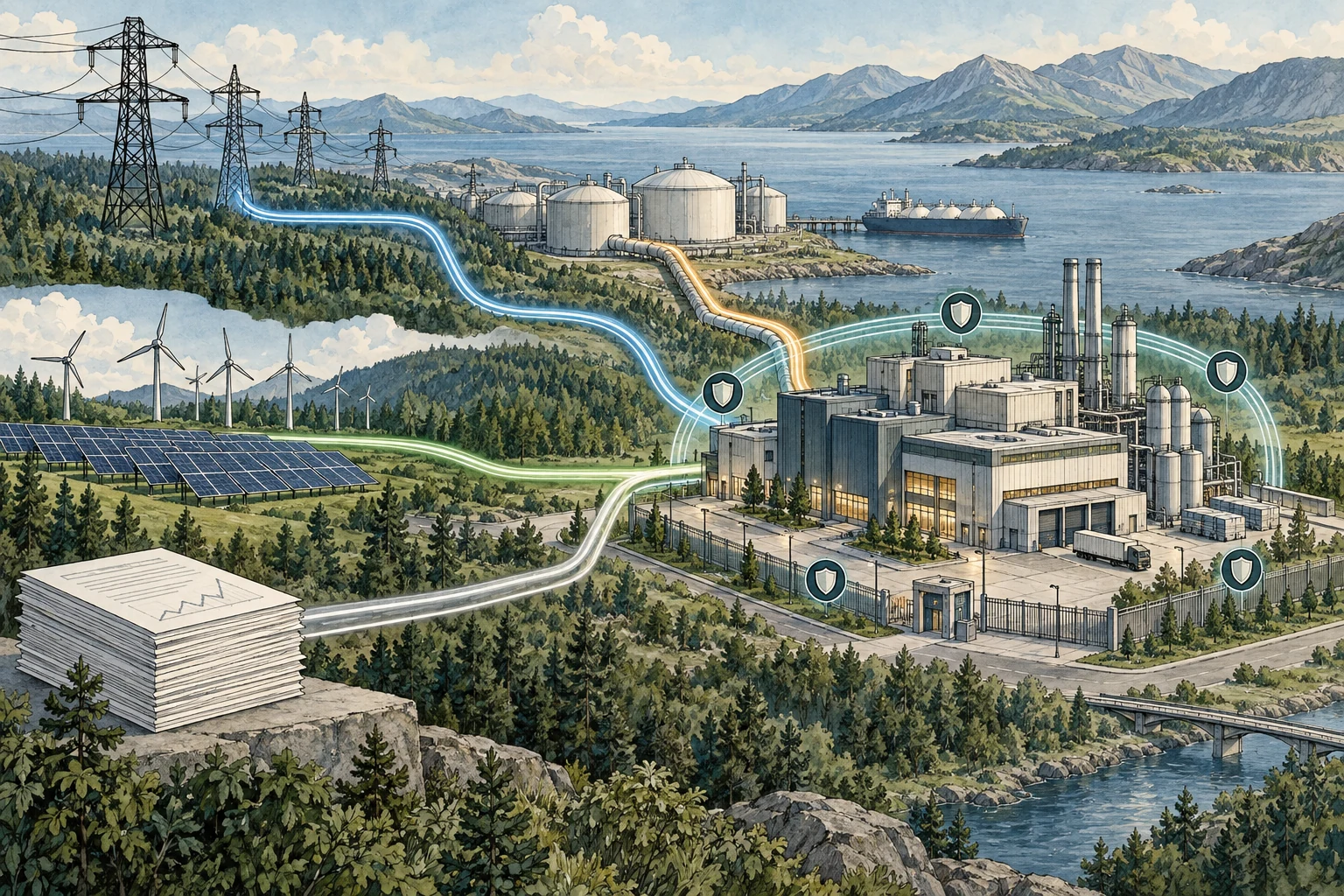
What makes a utility company more resilient
A large customer base can help a utility company assess consumption patterns and consolidate purchases. Different industries and consumption times can partially balance each other out. However, many customers do not protect against shared burdens such as sharply rising procurement costs. The key is how the portfolio is managed and financed.
Procurement with clear limits
Price commitments and hedged quantities are considered together. Binding limits and regular checks apply to any remaining open positions.
Money that is available in a timely manner
Equity absorbs losses. Available liquidity pays bills and collateral due today. A profit shown on the balance sheet does not replace bank balances.
Several viable supply routes
Different trading partners and procurement channels can limit dependencies. Shared upstream suppliers or the same infrastructure bottlenecks remain a risk.
Reliable processes
Forecasts, billing, staff cover, and availability must work even under pressure. A convincing presentation alone does not prove this performance.
In-house generation, access to storage, or a strong corporate structure can create room for maneuver. However, their value depends on availability, contractual access, and financing. A subsidiary does not automatically have access to all the resources of its parent company. A concrete guarantee is something different than a well-known corporate logo.
Existing customers secured early on
At the end of 2021 and the beginning of 2022, Stadtwerke Augsburg explained that its long-term procurement strategy protected existing customers, while additional customers had to be supplied at a higher rate in the short term. This illustrates the benefits of forward-looking procurement, but does not prove that all municipal utilities are inherently superior. Contemporary communication from Stadtwerke Augsburg.
Uniper also needed stabilization.
Uniper played a central role in electricity and gas supply and required government support in 2022. The federal government acquired a stake in the company in December. This demonstrates that systemic importance and size can justify political stabilization, but do not prevent economic crises. A government bailout of the next supplier cannot be inferred from this. Federal Ministry of Finance, December 22, 2022.
For your selection: Established suppliers with a proven track record of fulfilling their contracts deserve closer examination. However, municipal ownership, market share, or default supplier status are not a guarantee of creditworthiness. Whether a group of suppliers as a whole fared better through crises cannot be statistically deduced from these individual cases.
From annual demand to actual delivery
The starting point is your delivery points, operating hours, and expected electricity and gas volumes. The supplier translates this demand into tradable quantities and time periods. A uniform annual product, for example, is not a perfect fit for a business that only produces during the day or needs gas primarily in winter.

Forward procurement: agree today on terms for later delivery
A forward contract refers to a future period. It can lock in the energy price for a defined quantity. However, this does not mean your machine will be supplied with electricity today, nor will gas be automatically stored for you.
Energy exchange: standardized products and clearing
EEX German Power Futures are financially settled and relate to the German/Luxembourg electricity market. This financial settlement does not replace the separate organization of electricity delivery. EEX: How German electricity futures work.
OTC: agreed directly between contracting parties
Over-the-counter (OTC) means off-exchange. Quantity, timeframe, and terms can be individually agreed upon. A suitable transaction can then be registered for clearing; OTC therefore does not automatically mean without central settlement. EEX: Trade Registration.
Related: OTC and Clearing: Differentiating Trading Route and Settlement →.
For physically settled gas futures, delivery takes place at the agreed market area or virtual trading point. The subsequent supply chain to your delivery point still needs to be organized. Financially settled gas products, on the other hand, compensate for price fluctuations. Those who hedge on the Dutch TTF but deliver on the German THE must also take into account potential price differences between the market areas.
For your company, the supply contract is crucial: What quantity does the supplier deliver at what price, what deviations does he bear, and what costs does he pass on? We explain the basic models in more detail in Fixed Price, Tranches and Market-Oriented Procurement.
Six years of electricity, five years of gas – is that possible?
In principle, such timeframes can be secured. However, they are neither a general upper limit nor a guarantee for every company. The market area, product, and approved maturities must first be checked. Then, an executable offer tailored to your quantity and consumption profile is needed.
Maximum framework of EEX annual futures according to the specification.
Intended for THE and TTF, among others. EGSI financial annual futures: up to 9 years.
Product status: EEX Contract Specifications 0104a dated July 23, 2026, reviewed on September 15, 2026, sections A.1.1.8 and A.1.2.7. The exchange determines the actual released maturities. These are maximum limits of the product architecture, not verified order books and not binding delivery offers. Original specification, pp. 12 and 19.
A listed price is not yet a tradable offer.
A published settlement price is not a guarantee that you can buy any quantity at that price. Especially for distant delivery years, it's essential to check the matching counterparty, the quantity offered, and the difference between the buying and selling price. Low trading activity or a limited credit limit can increase the cost of an offer or even prevent it altogether.
Six years for electricity or five years for gas can therefore be a sensible enquiry horizon. Whether this period is suitable for you also depends on how certain your future demand is. A planned sale of a site, electrification, or new production technology can make a long-term commitment unsuitable. We are not claiming any current market liquidity for a specific delivery year.
If the market declines later, the fixed quantity may be more expensive than purchasing it later. This can be a consciously accepted price for planning security. The decision should be aligned with margin, budget, and risk tolerance.
Tranches need rules, not market sentiment.
With a tranche strategy, the planned quantity is procured in several steps. This way, the price doesn't depend solely on a single purchase day. However, the remaining quantity is exposed to market fluctuations. Even multiple unfavorable purchase times won't result in a favorable average price.
- Define needs
Electricity and gas separately, for each delivery year and location. Separate the firm base quantity from uncertain changes.
- Establish decision rules
Define timeframes, partial quantities, approvals, and the latest completion date. Who acts if the responsible person is unavailable?
- Keep open quantity visible
For each delivery year, show the quantities already fixed and still open, the components covered by the price and the potential budget impact.
- Track changes
Report new shifts, fewer orders, or plant modifications. Check whether additional purchases or sales are necessary.
A traceable report shows the date, delivery period, volume and agreed price for each purchase. With a fixed-price full-supply contract, the supplier usually organizes this within its portfolio. An individual customer therefore does not necessarily receive a separately allocated exchange-trade confirmation. Clarify what transparency your specific model offers and contractually commits to.
Why the annual amount alone is not enough
Quantity risk
You need more or less energy than planned. The difference must be procured or utilized. The contract stipulates who bears the resulting price difference.
Profile risk
The annual quantity remains the same, but the consumption shifts to different hours, days, or months. In that case, a uniform hedge may no longer match the actual consumption.
An electricity customer, for example, might add an extra night shift. With gas, a cold winter primarily affects heating demand; process gas consumption can be more dependent on capacity utilization. Therefore, consumption data, weather dependency, and planned operational changes should all be included in the forecast. How to prepare reliable load profile data.
What a balancing group has to do with it
A balancing group is, in simplified terms, an energy-related quantity account. For electricity, feed-in and consumption must be planned and economically balanced every 15 minutes. Schedules describe the planned quantities in the respective time intervals. Actual deviations are settled via balancing energy. TransnetBW: Balancing group settlement and forecast responsibility.
Related: Understanding the balancing group and schedule with a quantity example →.
For gas, imbalances are balanced, among other things, on a daily basis; in addition, the applicable intraday rules are relevant. A quarter-hourly rule for electricity cannot therefore be applied to gas without modification. Trading Hub Europe: Balancing energy prices.
Related: Why different balancing rules apply to gas →.
Your follow-up question: Are profile and balancing energy costs included or are they charged separately? Demand the same clarity as for the quantity band and settlement of excess and shortfall quantities . An external service provider can take over the balancing group management; however, the responsibilities must remain clearly defined.
Hedging can require cash today even if it protects you later
Clearing involves processing trades through a central counterparty. This requires collateral. Initial collateral covers potential value changes during the closing of defaulted positions. Daily variation margin distributes profits and losses from market price fluctuations between the trading parties. ECC: Guide to Margining, September 2026.
Related: Try out the payment effect of futures in the example →.
The market price is rising from €100 to €200/MWh.
The same open futures position of 1,000 MWh is considered. Fees, initial collateral and other transactions are excluded here.
Cumulative inflow from the equalization of value.
Cumulative outflow from the equalization of value.
Calculation: 1,000 MWh × €100/MWh price change. If the price decreases by the same amount, the payment direction reverses. The trend determines the individual daily payments.
A power producer on the selling side can later achieve higher revenues for their physical energy, but must finance the variation margin beforehand. A supplier on the buying side, on the other hand, receives money from the position when prices rise. With falling prices, they may have to pay before benefiting from cheaper physical purchases. The full effect only becomes apparent when considering the futures position, the physical transaction, and their timing.
Therefore, liquidity is a separate issue to consider. Even economically sound hedging can temporarily tie up a lot of money. Credit lines, collateral, and available funds must be appropriate for potential stress scenarios. The ECB documented this relationship in energy trading in 2022. ECB: Risks of energy derivatives markets.
An ordinary business customer does not automatically pay exchange margin requirements. Whether a supplier may require additional collateral, advance payments or adjustments depends on the customer contract and applicable rules. For over-the-counter transactions, collateralisation and credit limits also depend on settlement arrangements and agreements.
What a price guarantee can leave open
A procurement hedging agreement only fixes its defined scope. The complete invoice may still contain variable components: network charges, metering, taxes, levies, potentially CO₂ costs, guarantees of origin, and agreed service and risk items. Which of these are fixed must be explicitly stated in the offer.
Price hedgedA specific energy price is economically fixed.
Delivery organizedQuantities, market area, balancing and connection are assigned.
Partner solventThe contractual partner can fulfill its obligations.
None of these statements replaces the other two. A financial hedge guarantees neither the physical availability nor the supplier's solvency. Therefore, also review price adjustment, quantity, termination, and collateral clauses. The comparison should reflect normal operation as well as lower consumption, increased demand, and a potential supply interruption.
Eight pieces of evidence for a better supplier choice
Use the following questions as a basis for discussion. Not all information is publicly available or available in detail. Missing answers should remain visible in the decision note; a confidential trading strategy does not need to be disclosed for this purpose.
1. Who owes us the delivery?
Record the full name of the company and the contractual partner. Distinguish between group affiliation, guarantees, and the economically responsible entity. Is the guarantee binding, and if so, what is its amount and duration?
2. How up-to-date is the credit rating?
Assess the most recently published financial statements, available credit information, and any significant changes. Note the date and scope. Past profits, a rating, or an old financial statement do not prove current solvency.
3. How do price commitments and purchasing align?
Ask about hedging principles, limits on open positions, and responsible risk management. Don't assume complete hedging is guaranteed based on a fixed-price offer. Document the scope of the information available.
4. How are stressful periods financed?
Inquire about handling collateral requirements, available financing options, and concentration risks. What impact might changed credit limits have on existing customer contracts?
5. What do we pay for changes in quantity?
Have specific scenarios calculated to account for increased/decreased consumption, altered load profiles, downtime, and additional delivery points. Compare pricing formulas, reference periods, and reporting deadlines in writing.
6. Which experiences are actually documented?
Check references from comparable companies and traceable contract handling during previous stressful periods. Was the current contractual partner already responsible back then? "Many years in the market" alone doesn't answer that.
7. Who reacts in case of a malfunction?
Document availability, staff cover, billing verification, and escalation procedures. Clarify the connection level and local transitional or backup supply with the network operator. Not every business connection has the same fallback mechanism.
8. Which decision do we record?
Document the price, allocation of risk, open questions and approval together. For multiple procurement tranches, include purchase confirmations and the current hedging position. Assign a responsible person and the next review date.
The necessary documents are summarized in our Preparation of an Energy Tender. In the event of a failure, Part 1 leads directly to the Rules for Follow-up Electricity and Gas Supply.
Making a reasoned decision from the comparison
Stability cannot be confirmed with a single seal of approval. It becomes more transparent when consumption, contract scope, supplier, and financial risk are examined together. This is precisely where the comparison of offers should begin – before the signing is subject to time pressure.
What must your next contract deliver?
Please bring your electricity and gas contracts, annual consumption figures, contract expiration dates, and any existing offers. We will work with you to assess your needs, the desired scope of the price, and open questions for the supplier decision.
Discuss procurement with OPTUM →How we combine information, contract deadlines and human assessment in everyday life is shown in Market observation with OPTUM Pro.