

Annual consumption alone does not explain your electricity needs.
Your company requires one million kilowatt-hours per year. However, it's not yet clear when this energy will be needed. An extra shift, a broken furnace, or a sunny week with high solar power generation can all affect the timing of demand. Procurement must align quantity and timing.
Behind your energy supply, planned and actually allocated energy quantities are reconciled. Three terms help to understand this aspect of the supply: balancing group, schedule, and balancing energy. As a typical commercial customer, you don't need to engage in your own energy trading for this. However, you should be aware of which tasks your supplier handles and which deviation risks your contract leaves you with.
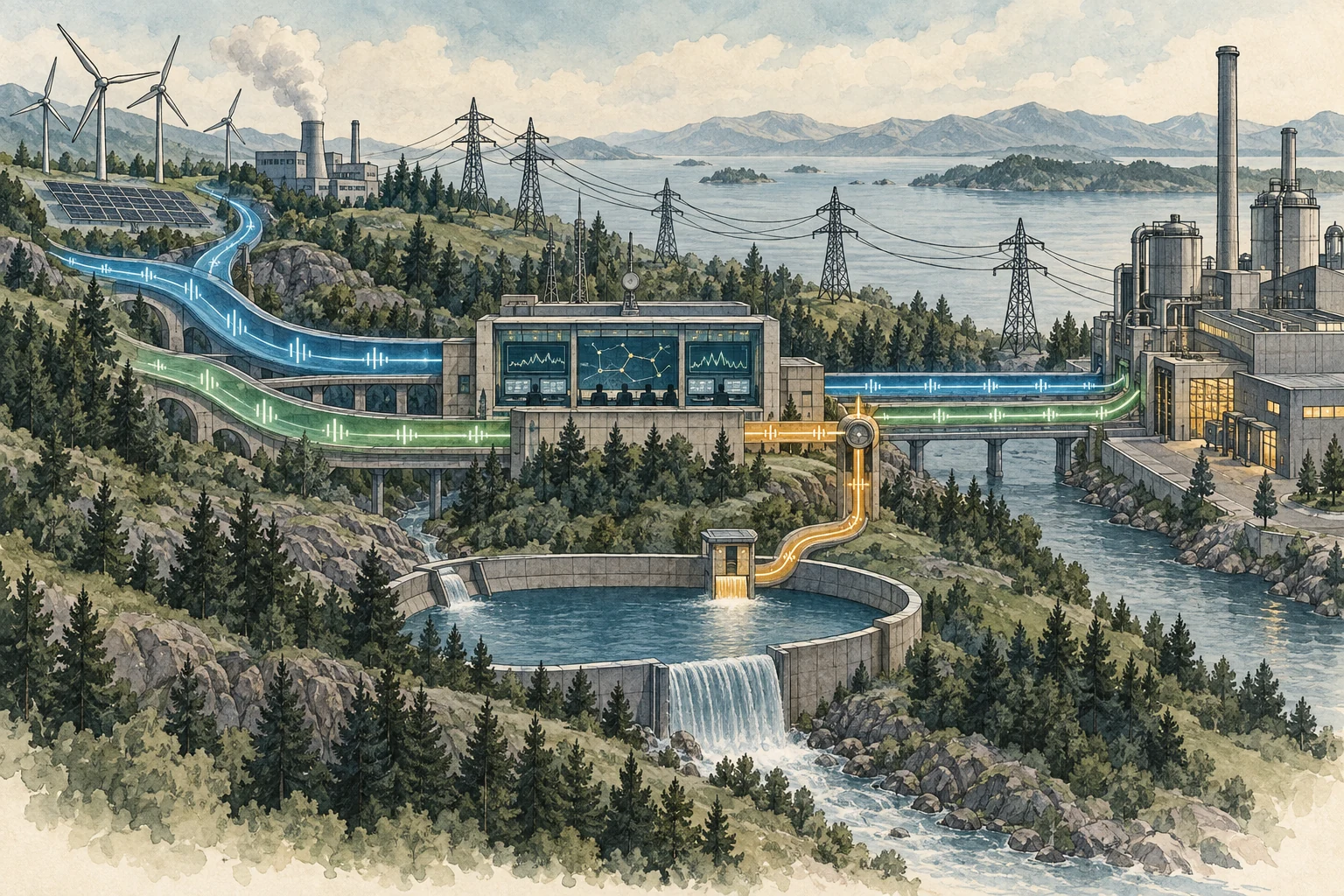
Balancing group, delivery schedule and imbalance energy: what do they mean?
Balancing group
A virtual quantity account. It tracks inputs, withdrawals, and trading transactions. It is neither a separate line nor a storage device.
Schedule
A time-resolved registration of planned energy quantities. The plan must match the expected demand and be adjusted as new information becomes available.
The balance group manager manages this account. In the electricity market, they must ensure a balanced account every quarter hour. Any remaining deviations are settled financially. The respective quarter-hour quantity is valued using the uniform balancing energy price across control areas, reBAP. The price, like the deviation, can have different signs; this can result in costs or revenues. The tasks and settlement process are explained in TransnetBW regarding balance group settlement .
Balancing energy is not the same as control energy. Control energy serves to physically balance the electricity system; balancing energy describes the financial settlement of the balancing group deviation. Therefore, an individual company does not automatically pay the currently displayed control energy price.
Planning. Tracking. Billing.
Why a balanced hour can still contain deviations
A simplified example considers only one consumption segment: 250 kWh were planned for each of four 15-minute periods. In reality, 200 kWh are needed initially, and later 300 kWh. The total consumption is again 1,000 kWh. The annual or hourly total may be correct, even though the consumption pattern differs over time.
| Time | plan | consumption | Increased/decreased consumption |
|---|---|---|---|
| 10:00–10:15 | 250 kWh | 200 kWh | -50 kWh |
| 10:15–10:30 | 250 kWh | 200 kWh | -50 kWh |
| 10:30–10:45 | 250 kWh | 300 kWh | +50 kWh |
| 10:45–11:00 | 250 kWh | 300 kWh | +50 kWh |
| Hourly total | 1,000 kWh | 1,000 kWh | 0 kWh |
The difference column simply represents consumption minus planned consumption; it is not a binding sign convention for balancing group settlement. In a real balancing group, additional customers, feed-ins, and trading transactions are involved. Furthermore, each quarter hour has its own price. Without this information, neither a customer charge nor a general savings can be calculated.
If you want to better understand the flow of your operations, start with the load profile in manufacturing. Before comparing offers, you should also check the completeness and quality of your load profile data.
Which of these will end up on your bill?
This is determined by your specific supply contract. In the case of full supply, the supplier often assumes significant responsibilities for forecasting and quantity management. The terms and conditions include corresponding services and risks. Additional provisions regarding quantity increases or decreases, tolerance bands, and exceptional changes in consumption may still be agreed upon.
In structured procurement or individually agreed models, volume, profile or balancing costs may be passed on separately. A label such as “fixed price” or “spot contract” is not enough to assess this. Check the actual cost provisions, not just the model’s name. A comparison is available under Understanding procurement models.
Four questions about the offer
- Who creates and updates the consumption forecast?
- What quantity and profile deviations are included in the price?
- How are additional costs calculated and documented?
- When do you need to report shutdowns or increased demand?
Four details from your company
- Planned shifts and company holidays.
- New machines or discontinued production lines.
- Self-generation and expected residual electricity demand.
- Contact person for short-notice changes.
Different energy balancing rules apply to gas
The quarter-hourly logic of the electricity market cannot be directly applied to gas. In the German gas market, Trading Hub Europe publishes balancing energy prices for the gas day; depending on the case, further intraday rules and charges may apply. The published values can be found at THE: Balancing Energy Prices. Your supply contract, however, governs quantity rules and tolerances.
For gas-intensive companies, a clear comparison of delivery time, consumption profile, and additional costs is therefore particularly helpful. Our article Procuring commercial gas and comparing offers guides you through this decision.
What you can improve with little effort
Start with the changes you are already aware of. A planned four-week shutdown is different information for purchasing than unchanged annual consumption from the previous year. Report such changes via the agreed channels and keep a record of the feedback.
In the next comparison, suppliers should calculate based on the same data. Otherwise, a seemingly lower price may simply be due to a different risk allocation. How to create a reliable basis is described in Preparing Energy Tenders.
Frequently asked questions from companies
Does our company need its own balancing group?
In a standard delivery, this is generally not the case. The decisive factor is who contractually assumes these responsibilities. In-house trading or generation models may require a different arrangement.
Is a consumption deviation automatically an error?
No. Even good forecasts don't perfectly reflect the actual outcome. Problems arise from unclear responsibilities, avoidable data errors, or conditions whose economic consequences weren't understood at the time of signing.
Are balancing energy costs always payable in addition to the standard charges?
No. Whether and how they affect the customer depends on the pricing and risk provisions of the contract. Have any separate charges explained to you based on the agreed-upon terms.