
Your company sets the framework.
Electricity comparison for businesses: consider the complete demand
Commercial electricity should be tailored to your business: to your working hours, annual consumption, individual delivery points, and desired predictability. Three factors need to align to help you make an informed decision: What is the total cost of supply, how long is your contract term, and how does the contract handle changes in consumption?
This guide takes you from determining consumption through price components and metering to contract duration and switching suppliers. Businesses, self-employed people and organizations will find the terms used on tariff sheets and in contracts, each with a relevant question to check. Specific conditions depend on the supply point, timing and contract scope.
Your existing bill and current contract are a good starting point. For larger or time-varying consumption, include any available load-profile data. To choose between fixed-price, tranche, spot-market and hybrid models, also see our procurement strategies.

Electricity for property management companies and multiple properties
Combine delivery points, contract holders and deadlines for each property.Read detailsClose details+
For multiple buildings, electricity for common areas, technical equipment, and individual user units should be clearly assigned. Record the supply point identifier, contract holder, contract duration, and consumption for each property. Not every contract can be consolidated on the same date.
A comprehensive overview shows which contracts are expiring soon and what quantities can be requested. The subsequent allocation of costs to individual owners or tenants remains a separate task. Further information on preparation can be found under Energy for Property and Condominium Management.
The commercial electricity price as a selection criterion
Compare expected total costs for the same period and demand. A low energy unit price can be offset by a higher standing charge or other fees. In tariffs with a demand charge, the power used as the billing basis can also affect the bill.
Document which figures are net and which are gross. A net price in one commercial offer is not directly comparable to a gross price in another offer. Bonuses should also be considered separately from the regular price so that the comparison remains transparent after the first year of delivery.
For example: 100,000 kWh at a freely chosen energy price of 25 ct/kWh results in consumption costs of €25,000. A basic charge of €240 per year increases the total to €25,240, assuming no other charges apply. This is a calculation aid and not a tariff offer.
What distinguishes commercial electricity from residential electricity?
Usage, contract design, and billing make the difference.Read detailsClose details+
Commercial and residential electricity differ primarily in usage, contract terms, and billing. The electricity still comes via the same local grid. The main differences between suppliers are the contractual conditions and the delivery process. Grid operation and the supply contract are separate responsibilities.
For businesses, individual consumption profiles, quantity agreements, and procurement models can have a greater impact on the terms and conditions. Legal rules and information obligations differ depending on the customer group and the contract. Consumer terms and conditions should therefore not be applied to a commercial contract without careful review.
Who can use commercial electricity?
From craftsmanship to production: what matters is the actual need.Read detailsClose details+
Commercial energy offers are aimed at businesses such as tradespeople, retailers, offices, restaurants, agriculture, and manufacturing companies. Other organizations may also require suitable supply contracts. The availability of a specific product depends on the supplier's terms and conditions and your delivery location.
There is no general consumption volume above which every business automatically receives more favorable conditions. Even a small business should therefore specify its actual needs and check the available offers.
The right data makes all the difference.
A quick self-check before comparing
Missing information doesn't all need to be provided before the first meeting. However, mark any outstanding details instead of estimating quantities or deadlines. This will allow you to prepare the next steps more effectively.
Determine your business's electricity consumption
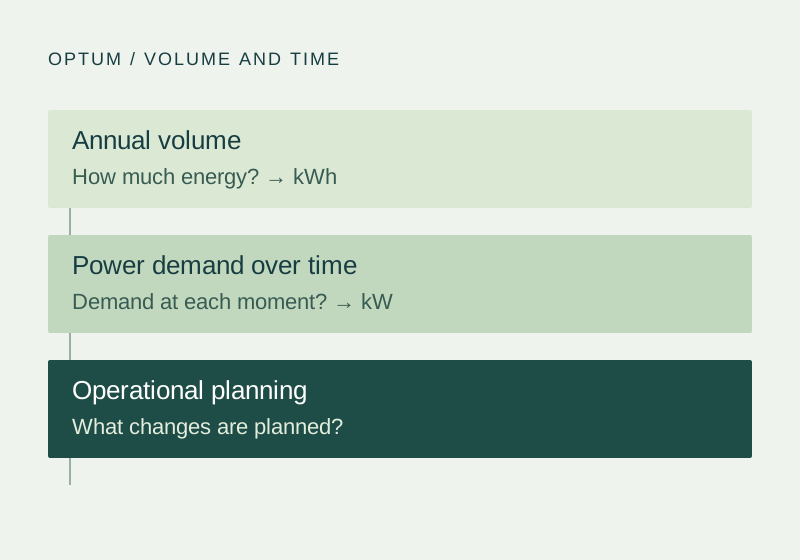
The last complete annual statement lists the kilowatt-hours consumed. Check the exact period, meter changes, and any potential estimates. If operating hours have changed or new equipment is installed, the previous year's figure is only a starting point.
For individual appliances: average power in kW × operating hours = energy in kWh. The electricity cost calculator combines these values with an entered energy unit price. An installation’s maximum connection capacity is not necessarily its average power consumption.
Document foreseeable changes separately. An additional shift, new refrigeration, or extended opening hours can alter demand. A comprehensible forecast is more helpful than a blanket safety margin unrelated to operations.
Three pieces of information describe your electricity needs.
- Quantity
How many kWh does your business need during the period under consideration?
- Course
At what times is this energy needed?
- change
What additional facilities, shifts, or locations will be added?
What does RLM mean?
RLM stands for registered load metering. This involves capturing time-resolved measurements; in the electricity sector, quarter-hourly values are frequently used. This data helps to describe the actual consumption profile of a supply point.
The applicable metering and balancing methods for your location are determined by your metering and network documentation. A general assessment based solely on a single consumption value should not replace an examination of your specific connection. Ask your metering point operator which consumption data you can access, in what file format it is available, and how up-to-date it is. This will allow you to determine which analysis is actually possible for your location.
For the evaluation, the unit, timestamp, and data quality are important. The article Load profile in manufacturing explains how average power and energy differ per quarter hour.
Understand the full price.
Tax treatment: Clearly separate the price basis
Clearly distinguish between net, gross and possible relief.Read detailsClose details+
For comparing offers, companies should clearly indicate net and gross values. Whether and to what extent VAT or other expenses can be taken into account for tax purposes depends on personal and/or business circumstances and should be reviewed by a tax advisor.
Potential relief or special levy rules should not be applied across the board to every business. An offer should clearly state the underlying conditions and the actual components included.
Understanding billing and advance payments
A low advance payment does not mean a low annual price.Read detailsClose details+
An advance payment is a prepayment towards a later bill. Its amount is not the same as the actual annual price. A particularly low advance payment can lead to a subsequent payment if consumption or price assumptions are incorrect.
Billing frequency and measurement basis may vary depending on the contract. Check the invoice based on the period, consumption, pricing rule, and payments already made. For multiple delivery points, allocation and payment processes should remain transparent.
Fixed charge, energy unit price and demand charge
The energy charge refers to the amount of energy supplied, usually in ct/kWh. The basic charge is a fixed amount per agreed time unit, regardless of the amount supplied. A capacity charge can additionally take into account the billed power in kW.
| Quantity | Relation | Test question |
|---|---|---|
| Energy unit price | ct/kWh | What consumption-dependent components are included? |
| Base price | €/month or €/year | Is the time unit identical in comparison? |
| Demand charge | Contractually billed kW | Which measurement and billing rule applies? |
Only add components that are not already included elsewhere. The exact total calculation follows the contractual pricing rules. Simply multiplying kWh by the advertised price is insufficient for more complex commercial contracts.
Energy quantity, power and time are different pricing factors
Refers to the amount of energy supplied.
Refers to the contractually relevant power, if agreed upon.
This is charged according to the terms of the tariff.
How is the commercial electricity price calculated?
Depending on how the energy purchase price is presented, network and metering costs, taxes, and other legal and contractual components may be added. Their amount and allocation can change over time. For comparison, place the current price list next to your last bill. Mark which costs are included in the quoted energy price and which are charged separately.
The EEG surcharge, for example, no longer belongs in a current price breakdown as an ongoing surcharge. After being reduced to zero in July 2022, it was abolished from 2023; the Federal Network Agency explains this development.
Request a clear breakdown including the effective date. Fixed pricing can include some components and exclude others. Only when this is clear can you assess what future changes are still possible.
Green commercial electricity: Bringing together evidence and targets
Check guarantees of origin and your own sustainability goals.Read detailsClose details+
When considering a green electricity offer, you should carefully examine the contractual statement of origin and the accompanying documentation. The label alone does not answer all questions regarding procurement, additional expansion of generation capacity, or the company's own sustainability goals.
For your company's communication to be accurate, statements must reflect the actual product agreed upon. A green electricity contract does not automatically reduce energy consumption. Efficiency measures and electricity procurement are distinct, complementary tasks.
The conditions also play a role.
What factors are important when choosing an electricity provider?
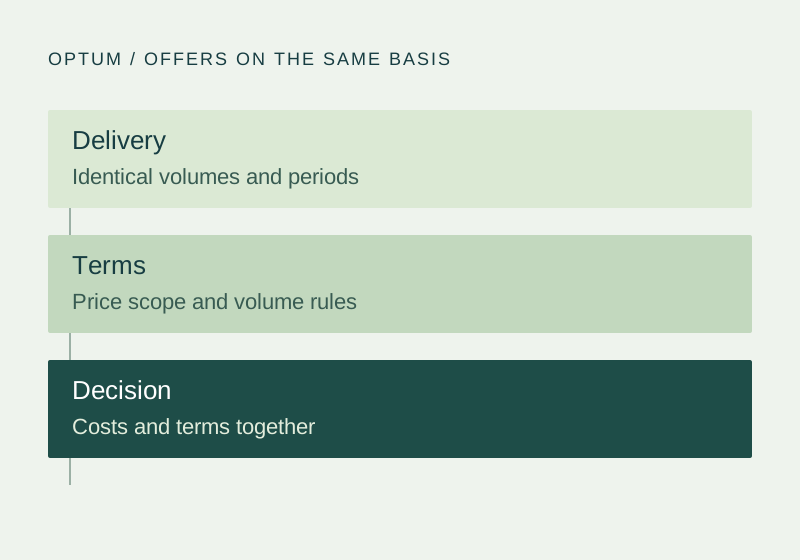
Price, contract terms, accessibility, and service quality are all interconnected. Also, check how changes in quantities, billing information, multiple locations, and customer inquiries are handled. A clear contract is especially important for complex consumption patterns.
Compare which tasks the supplier will undertake and which will remain with your company. Ensure that pricing formulas are transparent and that any verbal agreements are reflected in the binding offer.
Choose the appropriate duration
A longer contract term can make agreed-upon price components more predictable over a longer period. However, it also binds the company to these conditions for a longer time. A shorter contract term allows for a new selection sooner and leaves future purchasing options more open.
Take into account planned site changes and production development. Contract duration, delivery period, and price guarantee duration may not be identical. Check each of these details separately.
Keeping a reliable eye on notice periods
Note the contract end date, notice period, and renewal policy for each delivery point. The notice period specifies when the cancellation must be received; it is not the same as the end of the delivery service. In addition to the cancellation date, also include an earlier internal deadline for offer review and approval. This allows time before a binding decision needs to be made.
In the event of a price change or special circumstances, you should check the specific notification and the applicable terms and conditions. Our article Switching Electricity Providers explains the process for switching.
What a price guarantee actually covers
The price guarantee may be comprehensive or limited to specific components. Pay particular attention to excluded items, the validity period, and any contractually stipulated adjustments. The word "guarantee" alone does not adequately describe its scope.
Fixing a price protects the covered components against later market increases, but generally also prevents automatic participation in corresponding price decreases. This trade-off belongs in your procurement strategy.
New customer bonus and limited-time benefits
Consider one-time benefits and ongoing costs separately.Read detailsClose details+
A bonus can change the financial aspects of an offer. However, it should only be included if its requirements are met for your company. Check the timing, minimum duration, any exclusions, and the price after the bonus period.
Present the first year of delivery and subsequent periods separately. This way, a one-time payment doesn't mask permanently higher ongoing costs. Not every business offer includes a bonus, and an offer without a bonus isn't automatically worse.
Peak and off-peak tariffs (HT/NT)
Tariff periods, assigned quantities and measurement concept belong together.Read detailsClose details+
Peak and off-peak tariffs differentiate between contractually defined time periods or tariff categories. Whether such a model can be used depends, among other things, on the metering concept and the available tariff. It is not synonymous with a spot market tariff.
To make a comparison, you need the assigned quantities and prices for both tariff bands. A low off-peak price is of little use if almost all consumption occurs in the other band. The actual switching times and billing rules are what matter.
Weigh up the options of a deposit or prepayment.
Payment terms affect liquidity and risk.Read detailsClose details+
Advance payments and collateral affect liquidity and risk. Review the amount, due date, repayment terms, and the consequences of a breach of contract. A low energy price alone does not justify every additional payment condition.
Explicitly compare such terms and conditions with other offers. If the terms are unclear, request a clear explanation before concluding the agreement and internally assess the economic implications.
From comparison to the next step.
This turns a comparison into a change of provider.
After you make your decision, the contract acceptance, termination of the existing contract, and the new delivery start date must all align. Verify confirmations and unambiguous delivery point details. A submitted application is not automatically a confirmation of supply.
Since June 2025, the technical electricity supplier switch can take place within 24 hours on working days; existing contract durations and notice periods are unaffected. Find details and common questions in our article on how long an electricity switch takes.
During the transition, meter readings and subsequent final bills should be documented in a traceable manner. For multiple locations, a shared list of confirmed dates is helpful.