
Reading an electricity bill systematically
The invoice amount increases – but what has changed? Increased consumption, a different price, a longer period, or an additional cost item can all look similar. It's worthwhile for companies to answer these questions one by one. This provides the accounting department with a transparent basis for inquiries and the next price comparison.
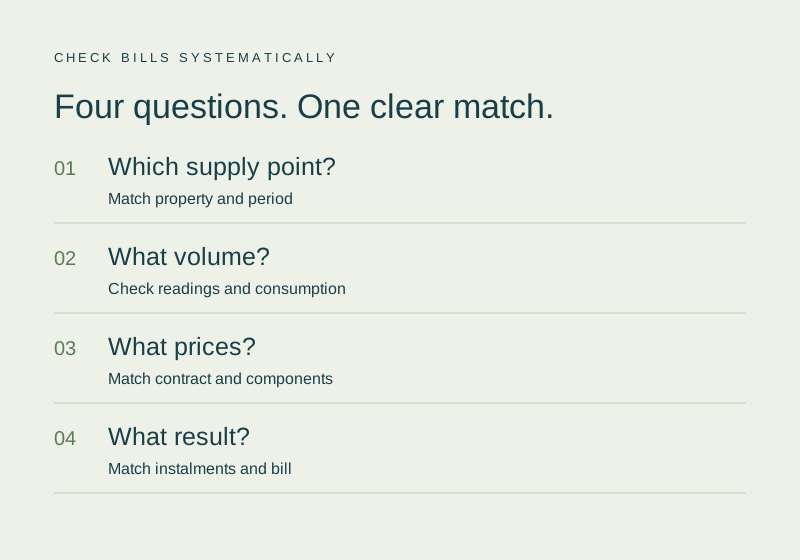
Start by verifying the information: Do the company, delivery point, meter number, and billing period match? The market location ID on the invoice identifies the point where energy is consumed; the meter number, on the other hand, identifies the measuring device. Next, check the billed quantity, agreed prices, and any advance payments already made. These checkpoints are also explained by the Federal Network Agency (Bundesnetzagentur) regarding the verification of energy bills. A company's specific invoice may contain additional contractual items.
A higher additional payment may also arise because fewer installments were paid during the year. Therefore, first compare the total costs for the billing period and then the payments credited.
Distinguish between quantity, price, and time period
First, compare the same time periods. A 13-month invoice cannot be directly compared to a 12-month invoice from the previous year. If there are price changes within the year, the respective partial periods need to be analyzed separately. A new machine, additional shifts, or another branch will also affect the comparison.

The energy unit price applies to the quantity of energy in kWh. Recurring fixed items may instead be charged per month or year. Connections with demand metering often have an additional demand charge: this applies to the power in kW used for billing, rather than the energy consumed in kWh. The Federal Network Agency explains this distinction between standing, energy and demand charges. The applicable case depends on the connection, metering and tariff sheet. Basis: structure of network charges.
Related: Understanding capacity pricing, peak loads and network charges →.
If the consumption is marked as estimated, compare it with available meter readings and operating hours. If, for example, a prolonged period of downtime does not match the estimated amount, note the period and the corresponding meter readings for your inquiry.
A calculation example for the consumption share
Let's assume a business requires 80,000 kWh in one year. Assuming a price of €0.20/kWh, this would cost €16,000. At €0.23/kWh, the same amount would cost €18,400. The difference is €2,400.
| assumption | Value |
|---|---|
| Consumption in both cases | 80,000 kWh |
| Price difference | 0.03 €/kWh |
| Difference in consumption share | 2,400 € |
Example calculation using net prices, not current rates: Only the quantity-dependent cost component is compared. Depending on the offer, other components may be added or already included. An item may not be added twice.
Bring offers onto the same basis
For each offer, note which components are included, which are billed separately, and which remain variable. Compare the same delivery period and consumption quantity. Keep net and gross values separate; monthly and annual figures should also be based on a common time period.
A lower individual price doesn't necessarily tell you which offer is the best overall. Price guarantees, quantity tolerances, and contract duration are all factors to consider. The Guide to Commercial Electricity provides further information on this comparison. For individual installations, the Electricity Cost Calculator can be helpful; however, it does not replace a thorough review of your electricity bill.
Prepare a specific follow-up question
Highlight the relevant item and note the contract, period, quantity, and your own calculation next to it. Clearly describe the discrepancy, for example: "The invoice shows 23 ct/kWh for the period from April to June. Our contract documents stipulate 20 ct/kWh. On what basis is the difference calculated?" If measured power triggers the question, include the load profile. Clarify responsibilities and any applicable deadlines based on your specific contract.