
Understanding gas consumption with the gas converter
The gas meter reads cubic meters, the bill kilowatt-hours. The gas converter for m³ to kWh combines both units: It calculates the corresponding energy quantity from the consumed gas volume, the gross calorific value, and the volume conversion factor. You can also calculate in the other direction and convert a known quantity in kWh to m³.
This allows you to calculate how your gas consumption is derived from your meter readings. Have your bill handy next to the calculator: the gross calorific value and volume conversion factor can be directly transferred. The calculator is suitable for private households as well as businesses and property management companies. For your company's energy procurement, the next step is to compare commercial gas offers.
The distinction between meter reading and consumption matters. A meter reading is a cumulative value. Consumption during a period is the difference between the final and initial readings. Enter that difference to convert gas consumption for the period. The entire displayed meter reading would be the wrong starting quantity.
You will need this information for the conversion.
To convert from m³ to kWh, you need the consumed volume and the two billing factors. The preset figures in the calculator are examples. Use the values specific to your metering location and reading period for your calculation.
- Gas volume in m³: New meter reading minus old meter reading. If you already have an invoice, you can use the volume consumption shown there.
- Gross calorific value in kWh/m³: The billing gross calorific value on your gas bill. It describes the energy content of the gas.
- Volume conversion factor: The factor specified on the invoice, often denoted by z. It takes into account the conversion from the operating state to the standard state.
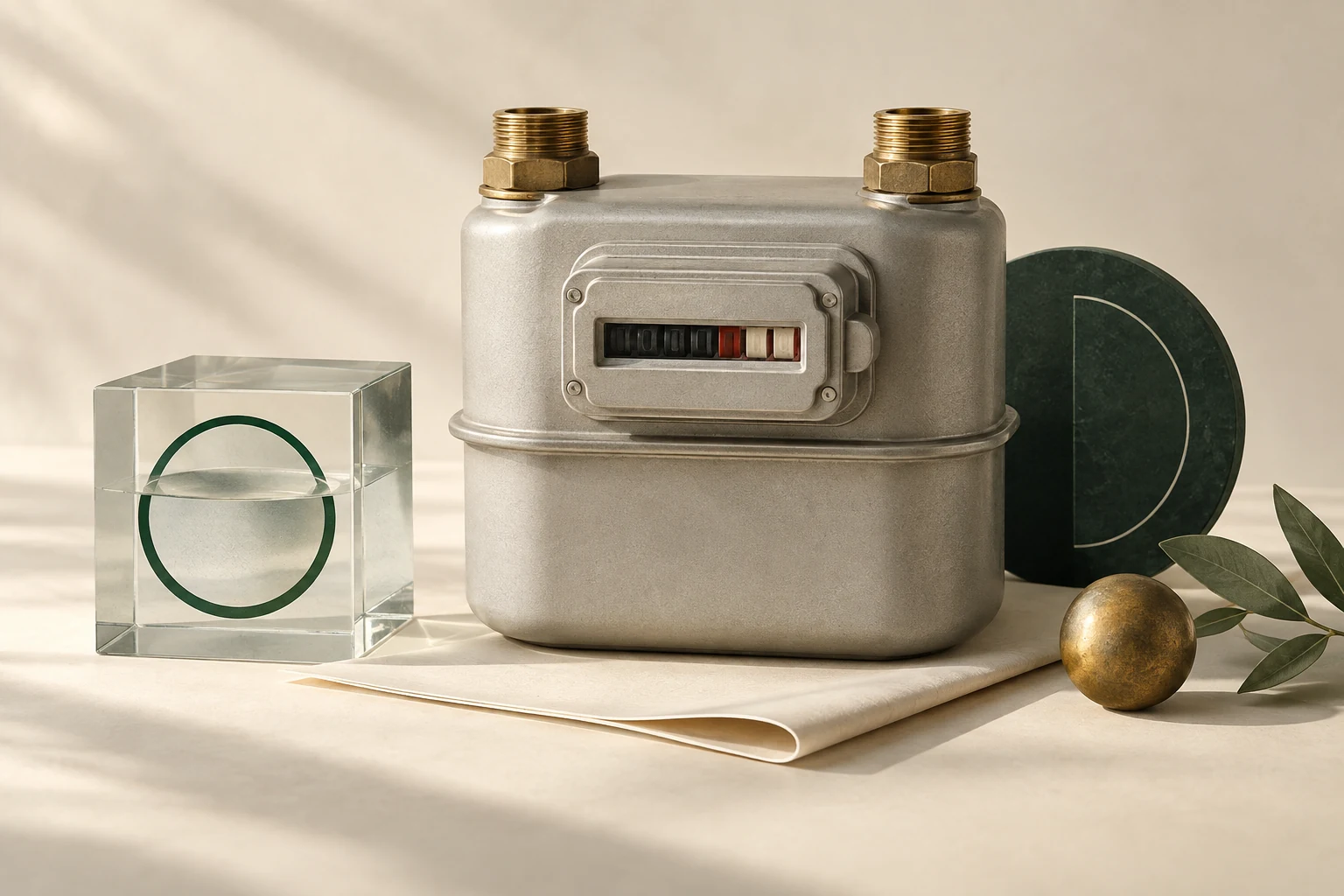
The bill accounts for energy.Your billing factors convert m³ into a transparent quantity in kWh. Illustrative gas-conversion image.
Three values. One comprehensible result.
FICTITIOUS INVOICE EXCERPT
- Old meter reading
- 12,450 m³
- New meter reading
- 13,450 m³
- consumption
- 1,000 m³
- Higher calorific value
- 10.5 kWh/m³
- Volume conversion factor
- 0.95
- energy
- 9,975 kWh
Different factors may apply to separate billing periods. Calculate each period separately, then add the energy quantities. One example gross calorific value for the whole year does not necessarily represent these differences.
If any of the information is missing, ask your supplier or network operator for the billed value. For a quick estimate, about ten kilowatt-hours per cubic meter is often sufficient. However, if you want to clarify a discrepancy on the bill, you will need the factors shown there. Also, check the unit: For this tool, the gross calorific value in kWh per m³ must be entered in the input field.
Why do meters measure m³ and bills measure kWh?
A cubic meter is a measure of volume. It corresponds to a cube with an edge length of one meter, and therefore 1,000 liters. A kilowatt-hour, on the other hand, is a quantity of energy. Both quantities describe different properties and therefore cannot be converted into each other using a universally valid conversion factor.
A cube with a length of one meter, a width of one meter and a height of one meter has a volume of one cubic meter.
Volume is not energy. Gross calorific value and the volume conversion factor turn the measured gas volume into billable kilowatt-hours.
Natural gas can have a different energy content per cubic meter depending on its composition. Furthermore, the measured gas volume depends on pressure and temperature. The gross calorific value and volume conversion factor establish the relationship to the billed energy. They are not freely selectable tariff parameters.
An example of power and energy
A constant power of 4 kW for two hours corresponds to an energy of 8 kWh: 4 kW × 2 h = 8 kWh. If the power rating refers to the heat output of a heating system, it does not automatically correspond to the gas energy consumed due to system losses. For gas billing, the measured volume and the billing factors are decisive.
This difference explains why the heating output on a nameplate alone is insufficient to determine actual gas consumption. Operating times, load, and efficiency also play a role. The meter reading provides the basis for the amount of fuel already consumed.
Compare multiple buildings or delivery points
Same formula. Different questions.
Home
Understand your consumption and how your bill is calculated. The meter alone does not show your energy costs.
Property management
Keep billing periods and values separate for each supply point. Converting units does not replace heating cost allocation.
Businesses
For procurement purposes, also compare delivery profile, annual quantity and contract terms.
For property and condominium management companies, a standardized data collection system for each property provides clarity. Record the meter number, start and end dates, both meter readings, as well as the gross calorific value and volume conversion factor. This allows values to be assigned even if the meters in buildings are read at different times.
First compare periods of equal length. Differences in floor area, vacancy, weather or central hot-water production can explain deviations. High energy consumption alone proves neither an incorrect bill nor an unfavourable contract. Energy procurement for property managers therefore considers volumes, contracts and deadlines together.
For an estimate based on floor area and a calculation from two meter readings, use the additional tool in Calculate gas consumption. Such an estimate is not a general model for process gas in a factory.
Gross calorific value: Energy content per cubic meter
The gross calorific value indicates the energy content of the gas. It includes the heat that can be additionally utilized when the water vapor produced during combustion condenses back into water. Technically, this component is called the heat of condensation. It depends on the gas composition. A higher gross calorific value means more energy per unit volume; however, it is not a simple measure of a supplier's overall "quality."
For the same amount of energy billed, a lower gas volume may be required if the gas has a higher gross calorific value. Therefore, price comparisons are based on kWh and the contractual price components. A comparison based solely on cubic meters can be misleading.
| Quantity | Unit | Use |
|---|---|---|
| Measured gas volume | m³ | Difference in your meter readings |
| Gross calorific value used for billing | kWh/m³ | Energy content from your billing |
| Volume conversion factor | without unit | Conversion factor from your statement |
| Billed energy | kWh | Result of the multiplication |
Gross calorific values in kWh/kg refer to fuel mass. Do not enter them into this tool without the appropriate additional conversion. Table values for LPG or heating oil are not substitutes for the factors used to bill piped natural gas.
Volume conversion factor: Consider temperature and pressure
Gas expands or contracts under changing conditions. At the meter, it is in its operating state. To ensure comparable billing, this volume is converted to its standard state using a volume conversion factor. The volume conversion factor is dimensionless.
The easiest way to find the conversion factor is to take it from your gas bill. It's usually listed next to the gross calorific value or consumption calculation. This factor reflects the conditions at your supply point; you don't need to calculate it yourself from temperature and pressure for this calculator.
Using the example values of 10.5 kWh/m³ and 0.95, 1 m³ contains exactly 9.975 kWh. The commonly used rule of thumb "one cubic meter is approximately ten kilowatt-hours" is therefore understandable as a guideline. For your own calculations, however, the specific product of the gross calorific value and the volume conversion factor remains crucial.
The volume factor puts gas volume on a common basis
- Metered operating volume
- Volume factor z
- Standard volume
Manually convert gas consumption from m³ to kWh
This is how the kilowatt hour on your bill is calculated.
The calculation can be followed in three steps. This example uses arbitrarily chosen values and is not a tariff offer.
- Determine the volume: Final meter reading of 13,450 m³ − initial meter reading of 12,450 m³ = consumption of 1,000 m³.
- Calculate the conversion factor: 10.5 kWh/m³ gross calorific value × 0.95 volume conversion factor = 9.975 kWh/m³.
- Calculate energy: 1,000 m³ × 9.975 kWh/m³ = 9,975 kWh.
The formula for both directions
kWh = m³ × gross calorific value × volume conversion factor
m³ = kWh ÷ (gross calorific value × volume conversion factor)
When calculating backwards, 9,975 kWh, using the same factors, again yields a volume of 1,000 m³. Round intermediate results as late as possible. Small discrepancies from the bill can arise, for example, from rounded figures or separate billing periods.
From energy quantity to costs
Multiply the kWh by your energy unit price in euros per kWh. At an explicitly assumed example price of 10 ct/kWh, 9,975 × €0.10 = €997.50 is the consumption-related cost. Other agreed price components, such as a standing charge, are additional. Divide a price entered in cents by 100 to calculate in euros.
For a comparison, consistently use either prices excluding VAT or prices including VAT. The gas conversion calculator calculates energy, not a complete supply bill or an automatically achievable saving.
What you can check after the calculation
If the kWh match your bill but costs seem too high, next compare the energy unit price, standing charge and billing period. If the energy quantity already differs, begin with meter readings and conversion factors. This focuses your enquiry on the right issue.
Frequently asked questions about the gas converter
How many kWh are in 1 m³ of gas?
This depends on the billing gross calorific value and the volume conversion factor. Multiply these two factors to convert exactly one cubic meter. For example, with 10.5 kWh/m³ and 0.95, the result is 9.975 kWh. Different values may apply to your delivery point.
Can I enter the meter reading directly?
To determine consumption for a given period, you need the difference between two meter readings. Only if the initial reading was zero will the final reading accurately reflect the consumption for that period. When replacing a meter, the readings from both devices must be considered separately.
How do I convert cubic meters to liters or cm³?
1 m³ is equivalent to 1,000 liters and 1,000,000 cm³. To convert cm³ to m³, divide by one million. These are purely volume conversions; for an energy quantity in kWh, you also need the gross calorific value and the volume conversion factor.
Does the gas meter display the costs?
A standard gas meter displays the measured volume. Costs only arise from the conversion of this volume into energy and the application of the agreed tariff. A higher bill can be due to increased consumption, changes in prices, or a different billing period.
Why doesn't a simple estimate exactly match the bill?
First, compare the cubic meter consumption, then the gross calorific value and the volume conversion factor. If these three figures match, check the individual billing periods and rounding. An estimated meter reading can also lead to a discrepancy. Note the relevant period and your bill; this will allow the supplier to answer your inquiry specifically.
How do I additionally calculate the electricity consumption?
For electrical equipment, energy is average power in kW × operating hours. The electricity cost calculator combines power, operating time and your energy unit price into a consumption-cost example.
Technical basis for gas billing: DVGW – How does gas billing work?