
Calculating gas consumption: measuring or estimating
How much gas have you used, and what is your expected consumption next year? These questions require different calculation methods. Using two meter readings, you can determine the amount of gas consumed over a past period. Using living space and a suitable building energy performance indicator, future consumption can only be estimated approximately.
Our calculator offers both options. The living space estimate serves as a guide for residential buildings and property management companies. For commercial spaces and industrial process gas, actual billing data, load profiles, and operational data are required. The conversion of measured cubic meters to kilowatt-hours, on the other hand, works with the appropriate billing factors, regardless of usage.
Gas consumption from meter readings: Step by step
- Note the beginning and end readings of the same gas meter, as well as both reading dates.
- Subtract the initial reading from the final reading. The result is the consumption in cubic meters during the measured period.
- You can find the gross calorific value and volume conversion factor in the corresponding invoice.
- Multiply cubic metres × gross calorific value × volume conversion factor to obtain kilowatt-hours.
Example: 12,500 minus 12,000 m³ equals 500 m³ consumption. With an example gross calorific value of 10.5 kWh/m³ and a volume conversion factor of 0.95, this results in 4,987.5 kWh. These factors are example values; use the data from your billing period for your calculation.
When changing meters, the readings of different meters cannot simply be subtracted from each other. The final reading of the old meter and the initial reading of the new meter must be considered separately. Also, check whether a meter reading was actually taken or estimated.
This is how the estimate in the gas consumption calculator works.
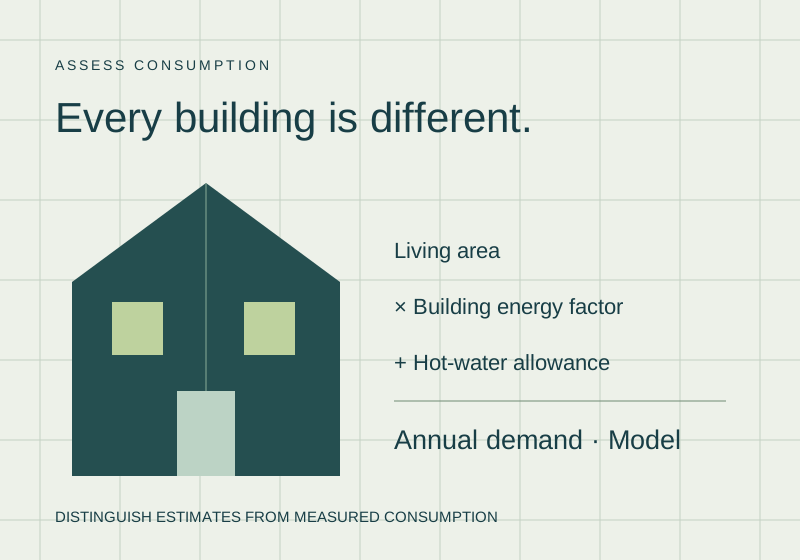
The calculator above uses a deliberately simple model: living area × building consumption factor + hot-water allowance = estimated annual consumption. For gas-heated hot water, the model adds 800 kWh per person per year. This allowance is omitted if hot water is not heated with gas.
The preset values of 140 and 250 kWh per square meter per year are model assumptions and do not represent the energy consumption of every building. Alternatively, you can enter your own suitable value. A value that already includes hot water must not be increased again to include the hot water component.
Example: 90 m² × 140 kWh/m² equals 12,600 kWh. For two people and gas-fired hot water, the model adds 1,600 kWh: a total of 14,200 kWh per year. The monthly, weekly, or daily figures mathematically divide this annual value. They do not reflect an actual seasonal consumption curve.
The calculation does not take into account individual weather conditions, the exact system technology, room temperatures, or ventilation. Use it for a rough estimate and then compare the result with billing, building data, and actual usage.
Classify multiple residential buildings and delivery points
If you manage multiple buildings, first calculate consumption for each property individually. This way, you can identify which building has unusually high consumption and which bill corresponds to it. Record the delivery address, meter or supply point, billing period, floor area, hot-water type and annual consumption for each property. Different time periods should be clearly indicated before comparison.
A key performance indicator (KPI) measured in kWh per square meter can reveal differences. However, it doesn't explain their cause on its own. Vacancy rates, building standards, heated areas, weather conditions, and usage can all vary. An unusual value warrants further investigation, but it doesn't automatically prove an inefficient system.
Internal heating cost allocation is a separate task and is not performed by this calculator. For information on obtaining and managing multiple contracts, please see Property and Condominium Management.
Average gas consumption: How to use tables correctly
An average value is only helpful if its reference point is clear. Therefore, the following table explicitly shows calculation examples and not measured average values for the building stock. Only the area-related model component is given, without any additional hot water allowance.
| Living space | 140 kWh/m² per year | 250 kWh/m² per year |
|---|---|---|
| 35 m² | 4,900 kWh | 8,750 kWh |
| 60 m² | 8,400 kWh | 15,000 kWh |
| 90 m² | 12,600 kWh | 22,500 kWh |
| 140 m² | 19,600 kWh | 35,000 kWh |
| 200 m² | 28,000 kWh | 50,000 kWh |
A larger surface area proportionally increases the model consumption for the same key performance indicator. A real building may deviate significantly from these examples. For reliable budget planning, several existing annual statements and known changes are more helpful than a blanket classification as "normal" or "too high".
Gas consumption by number of people: the hot water share
The number of people in a household primarily affects hot water usage. It is not a sufficient measure of heating energy demand: one person in a large, poorly insulated apartment can require more heating energy than several people in a small, well-insulated apartment.
| persons | Addition in the simplified hot water model |
|---|---|
| 1 | 800 kWh/year |
| 2 | 1,600 kWh/year |
| 3 | 2,400 kWh/year |
| 4 | 3,200 kWh/year |
These values are the calculator's assumptions. Actual amounts depend on factors such as usage, hot water temperature, circulation, storage losses, and the system itself. This gas addition should not be considered for electric water heating.
Gas consumption by type of property
Detached houses, terraced houses, and apartments differ in their heat-loss surfaces. Other factors include insulation, windows, room layout, heating system, and occupancy. Even a renovated older building can have lower energy requirements than an unrenovated newer property.
Commercial properties have different ceiling heights, opening hours, ventilation requirements, and technical processes to consider. Therefore, a residential floor area chart should not be applied to factory buildings, restaurants, or production facilities without careful consideration. Instead, use actual consumption patterns and the planned business use.
Determine the actual measured gas consumption
You do not need to wait for the annual bill to determine consumption. Two documented meter readings are enough for the period measured. For accurate energy billing, you also need the applicable conversion factors. The gas conversion calculator explains gross calorific value and the volume conversion factor in detail.
However, a short summer period cannot simply be used to extrapolate an entire heating year. Heating and hot water consumption have different seasonal patterns. Whenever possible, compare periods of similar length and usage; for larger buildings, a separate, professional analysis is necessary to adjust for weather conditions.
A simple meter reading log with date, meter number, reading, and any special circumstances helps to classify later discrepancies. The unit of energy consumption is kilowatt-hour, not kilowatt.
Gas for hot water and heating: sensible starting points
In residential buildings, gas is frequently used for space heating and hot water. Which use accounts for the larger share depends on the building and the system. Consumption can be better assessed when operating times, settings, and actual demand are known.
Avoid unnecessary hot water usage and check for suitable water-saving fixtures. However, any changes to drinking water systems, storage temperatures, or circulation must comply with hygiene and technical requirements. Discuss any changes to these settings with your qualified technician instead of experimentally reducing the hot water supply.
Even in winter, occupied rooms need fresh air. How long and how often you ventilate depends on usage, humidity, and the weather. Monitor the humidity level and avoid leaving windows permanently tilted while the heating is on. Have your heating controls and heat distribution checked if rooms heat up to very different temperatures despite the same settings.
Underfloor heating and fuel cell heating
Underfloor heating distributes heat throughout the room. Its gas consumption also depends on the heat generator and the building's energy requirements. Therefore, it is not a separate, fixed consumption category from which a single annual figure can be calculated. Low, suitable system temperatures can be helpful for efficient operation, but they must be appropriate for the entire system.
A fuel cell heating system generates both heat and electricity. Both energy flows must be considered when evaluating it. A comparison based solely on the amount of gas consumed is insufficient. Operating times, heat utilization, and system design are all part of a comprehensive technical assessment.
Area calculation without false accuracy
Assuming a specific scenario with 50 to 100 kWh per square meter per year, 140 m² would theoretically result in 7,000 to 14,000 kWh per year. This range is a calculation example, not a general consumption forecast for every underfloor heating system.
New building and old building: Year of construction alone is not enough
The year of construction can provide clues, but it doesn't replace a description of the current condition. Subsequent insulation, windows, roof, system replacements, and changes in use all affect energy consumption. Therefore, a blanket cutoff like "pre-2002" doesn't reliably assign a building a specific energy consumption factor.
Our calculator requests a building characteristic value. Use a value appropriate for the building and the energy quantity under consideration, ideally from reliable documentation. Demand stated in an energy performance certificate, measured consumption, and simplified estimates are not automatically identical.
For each metric used, please specify the document it comes from, the year it refers to, and whether it includes hot water. This prevents hot water consumption from being counted twice and simplifies later comparisons.
Gas consumption too high: Systematically check for deviations
A higher bill can result from increased consumption, higher prices, or both. First, compare your consumption in kWh, the time period, and the energy and basic charges. Then, check the meter reading method, meter assignment, any retrospective billing adjustments, and changes in usage.
- Are both billing periods the same length?
- Were the meter readings measured or estimated?
- Were there new residents, different operating hours, vacancies, or renovations?
- Have the weather conditions or heating settings changed?
- Are there any technical issues that should be checked by a specialist company?
Technical faults cannot be ruled out entirely. Unusual consumption should be investigated objectively. In case of a gas odor, safety takes priority: Avoid flames and electrical switching operations, warn others without ringing doorbells, leave the building, and call the emergency service or fire department from outside. The DVGW guidelines for gas odors describe the procedure.
Frequently asked questions about gas consumption
What is a cubic meter?
A cubic meter is the volume of a cube with sides of one meter and is equivalent to 1,000 liters. The unit itself does not specify temperature or pressure. For gases, these conditions are additionally relevant for energy conversion.
How do I convert cubic meters to kilowatt hours?
Multiply the consumed volume by the gross calorific value and the volume conversion factor for the relevant billing period. The DVGW explains gas billing and the quantities used.
Related: Convert gas quantity step by step from m³ to kWh →.
What is the gas consumption in Germany?
In 2025, Germany consumed a total of 864 terawatt-hours of gas, or 864 billion kWh. This was approximately 2.2 percent more than in 2024. These figures come from the 2025 annual review of the Federal Network Agency. For your building, a comparison with your own previous years and similarly used properties is more helpful: The national total also includes industrial processes.
Can I also use it to calculate electricity consumption?
Gas volume uses different conversion quantities. For electrical equipment, use power and operating time. The electricity cost calculator shows consumption and the corresponding cost component.