What level of uncertainty can your company tolerate?
The question of the best procurement model sounds like a price forecast. In practice, other things take precedence: How certain must product cost calculations be? How much can consumption fluctuate? Who is authorized to make purchasing decisions? Without these answers, even a detailed offer remains difficult to compare.
First, document your requirements on one page. This includes the delivery period, expected quantities, budget, and responsibilities. Add any planned changes to production and locations. This common foundation will reveal which model best suits your company.
Do you need to commit to sales prices far in advance? Then a reliable cost basis is particularly important. If you have some budget flexibility and can continuously assess price changes, then open market price shares are also a viable option. This provides a selection for comparison, but not an automatic recommendation for a contract.
Fixed price: Understanding the scope of the commitment
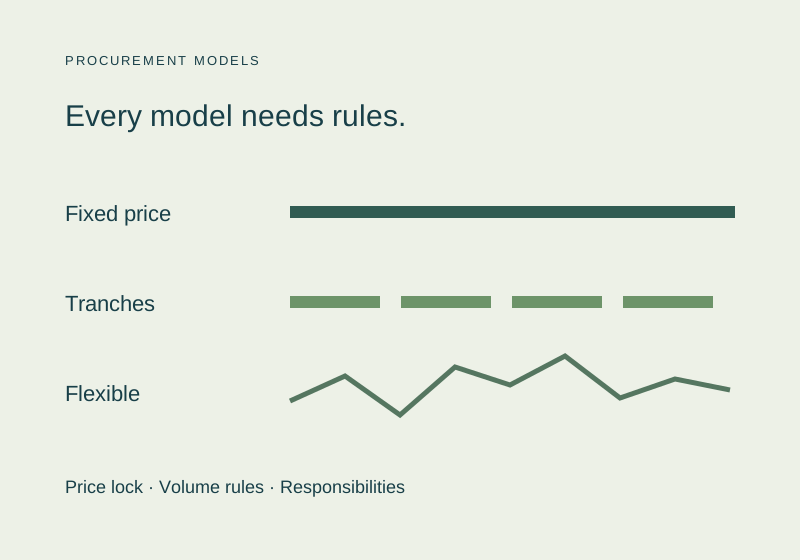
In the fixed-price model, the agreed price components are fixed for a defined period. This makes the calculation of these components more predictable. The agreed scope, exceptions, and quantity rules remain crucial. A price guarantee can be limited to selected costs. The Federal Network Agency explains the significance of price guarantee clauses.
Therefore, ask specifically: Which items remain fixed, which can be adjusted, and what happens in the event of higher or lower consumption? A pre-agreed price does not automatically protect against the overall bill increasing due to higher quantities. Likewise, a portion that has already been fixed does not immediately reflect subsequent market declines.
Tranches: Multiple decisions require clear rules
In tranche procurement, the planned quantity is procured in partial quantities at different times. This distributes the purchase dates but does not guarantee a lower average price. The specific details depend on the contract. An overview of cut-off date, index, and tranche models is provided by the IHK Osnabrück on energy procurement.
Related to this: Classifying purchasing times and tranches for companies →.
Example calculation with assumed prices for equal sub-quantities: Four pure energy prices of €80, €100, €120, and €100/MWh average out to €100/MWh. For unequal sub-quantities, a larger purchase has a greater impact: Multiply each sub-quantity by its price, add the amounts, and divide by the total quantity. These figures are not current market prices. Also, define approval criteria, time windows, and a procedure for any remaining quantities.
Understanding flexible procurement components and combinations
A variable component can reflect short-term market prices. This means that opportunities for lower prices remain, as do the risks of higher prices. The actual effect depends on the quantities billed and when. The article Dynamic Electricity Tariffs for Businesses explains why your own consumption patterns are crucial.
In a combined system, each component needs a clear rule: What quantity is secured, what remains open, how are deviations handled, and what surcharges apply? Terms like "hybrid" are insufficient for this purpose. Even a long-term green electricity supply via a PPA (power purchase agreement) with a producer must match consumption. Additional electricity required by the business and periods without suitable generation necessitate separate procurement rules.
A decision proposal instead of a bet
Compare the models on one page: fixed price components, unhedged volumes, organizational effort and the effect of an adverse scenario. Then examine two questions: How would a higher market price affect the budget? Who decides when another purchase is due? If nobody in the business can continuously assess and approve offers, the process must be correspondingly simple or supported through a clearly agreed service arrangement.
For your exchange with OPTUM, please bring your annual consumption, your current contract, and the desired planning certainty. Together, we can prepare a comparison that takes into account price, consumption, and your decision-making processes. For market fundamentals, Spot Market and Futures Market provide a deeper understanding of the mechanics. The next steps for obtaining a concrete offer can be found in Commercial Electricity and Commercial Gas in the Offer Comparison. While a transparent process can be verified, it cannot guarantee the most favorable future purchase time.