What should the green electricity supply demonstrate?
A customer inquires about the origin of your electricity. The purchasing department has a green electricity offer, and management is considering a long-term supply from a specific power plant. These concerns are related, but they require different documentation. Therefore, start with the purpose: Is it about electricity labeling, a procurement decision, or a clearly defined statement to business partners?
Before issuing the tender, specify which locations, electricity volumes, and time periods are being considered. Then define the desired characteristics. "Renewable," "from a specific region," and "from a new plant" are different requirements. A bid should clearly demonstrate which of these requirements are actually met and documented.
What guarantees of origin achieve
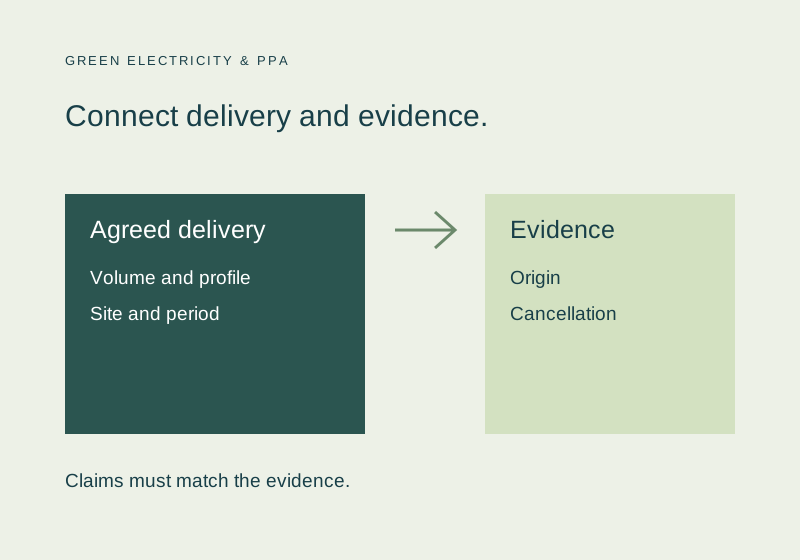
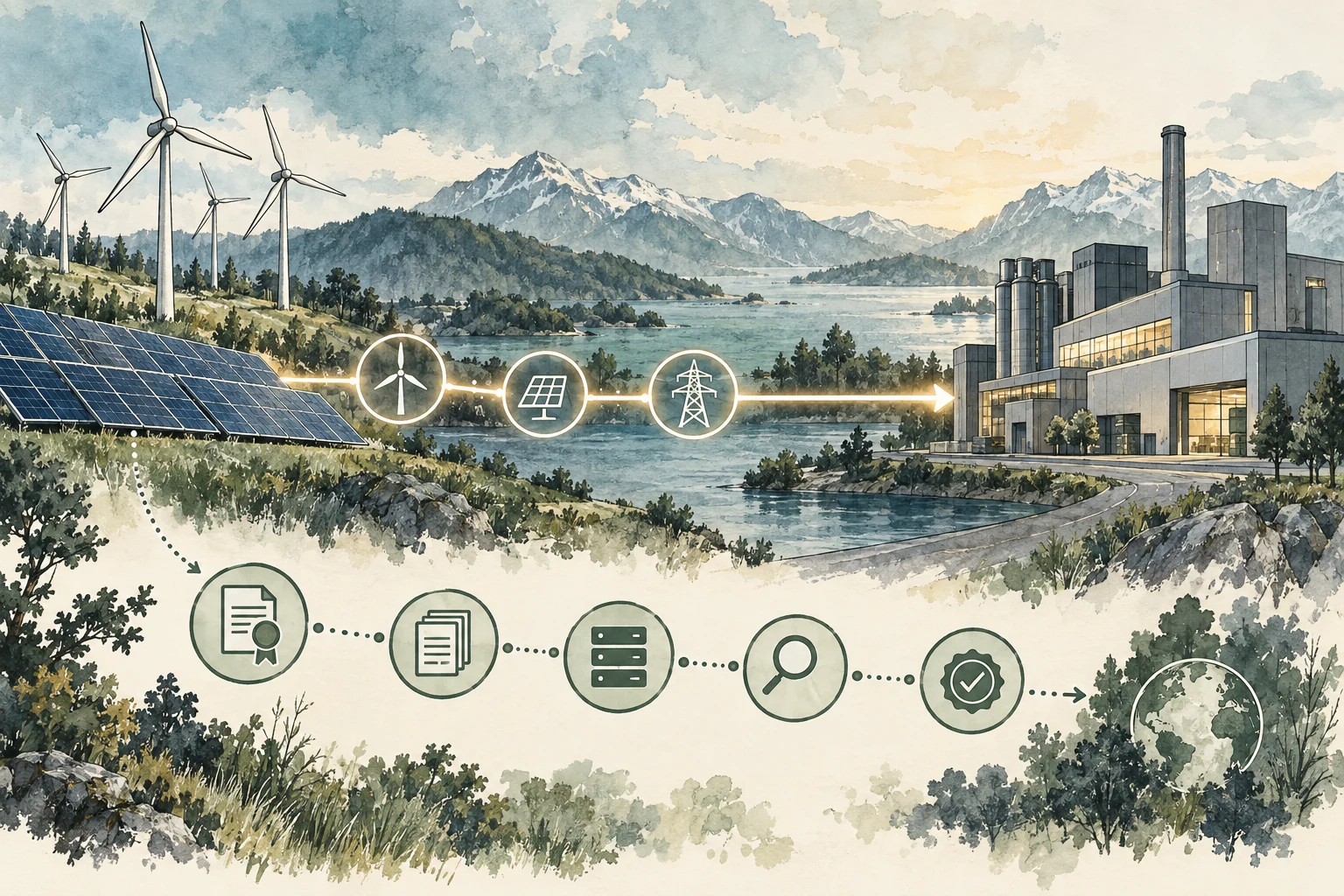
A guarantee of origin is an electronic certificate for one megawatt-hour (1,000 kWh) of electricity generated from renewable sources. It includes information about the installation, energy source and generation period. When used for electricity disclosure, it is cancelled in the registry: the same certificate cannot then be used again. This does not imply a physical connection between the installation and your business, or automatically provide additional environmental benefits. The German Environment Agency explains guarantees of origin and electricity disclosure.

Ask the supplier for clear documentation of the agreed-upon product and the correct delivery period. Check whether the quantities, locations, and origin characteristics match your order. A promotional logo on the offer does not replace this verification. If an additional label is relevant, its criteria should also be checked.
A PPA is also a question of the delivery profile.
A Power Purchase Agreement (PPA) can contractually regulate the long-term procurement of electricity from renewable energy sources. For ongoing operations, it is crucial to know the quantity delivered at what time and who handles any deviations. With a production-based delivery model, often called "pay-as-produced," the amount of electricity depends on the actual output of the plant.
In contrast, a supply band provides an agreed power level over the specified delivery times. Both can align with your consumption, but require different approaches to handling excess or shortfall quantities. This article focuses on PPAs with electricity delivery.
The German Energy Agency (dena) provides a sample contract with explanations for a PPA supply band. It illustrates the importance of the supply structure, integration into existing contracts, and appropriate contract assumptions. This sample is a starting point, not a universal solution for every company. Source: dena, Guidance Notes on the PPA Supply Band.
Coordinate remaining electricity needs and certificates
Let's assume your business requires 1,000 MWh per year and a contract provides for 600 MWh of renewable energy supply. The remaining 400 MWh is initially just a quantity calculation. It doesn't automatically mean that 60 percent of your consumption is covered every hour. For practical supply, the time profiles and the handling of over- and under-supply must be examined.
If parts of the 600 MWh are delivered at times when the business does not need them, surpluses and additional purchases in other hours can arise alongside one another. Therefore, the calculated 400 MWh does not yet represent a complete residual electricity plan.
Clarify who integrates the PPA volumes into your existing supply contract and settles any timing discrepancies. Balancing includes allocating feed-in and offtake; this task is typically handled by a designated market partner. Additionally, document who supplies the remaining electricity, which guarantees of origin are agreed upon, and who internally reviews the documentation. For on-site generation, the article Photovoltaics, Storage and Residual Electricity Contract may provide further assistance.
Statements as precise as the evidence allows
Reliable communication specifies the location, time period, and documented electricity supply. General statements about the entire company often go beyond this documentation. Whether a specific formulation is permissible for advertising or reporting and sufficient according to the applicable standard requires separate review.
For procurement, OPTUM recommends a joint requirements list from the purchasing department and the internal sustainability officers. This list should include documentation requirements alongside price, contract duration, and quantity rules. It is essential to explicitly state whether documentation must originate from the agreed-upon facility or can be substituted under certain conditions. This makes it clear during the initial bid comparison which claims regarding the origin of the energy can be substantiated later. Comparing different procurement models supports economic evaluation; the commercial electricity consulting service consolidates these requirements.