
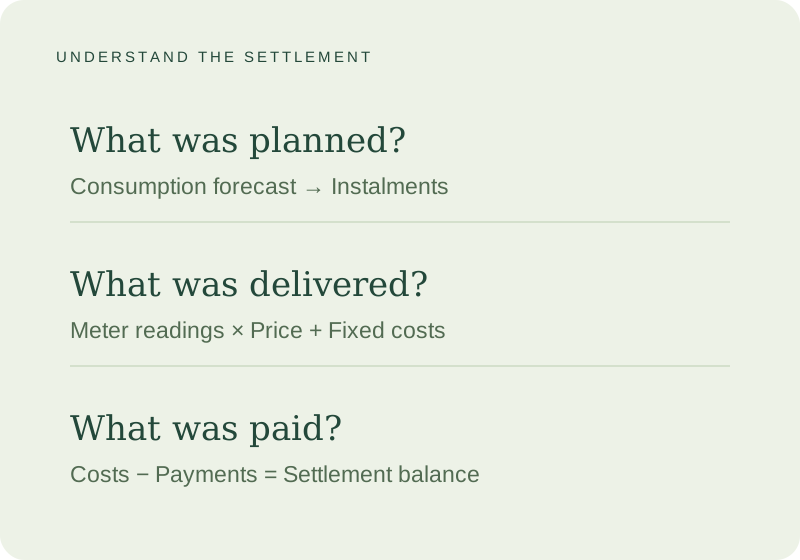
Why a supplementary payment is required despite advance payments
The basic calculation is as follows: Costs of the billing period minus eligible payments equals the payment balance. If this balance is positive, a payment is due. If the payments credited exceed the costs, a credit balance results. Any further credits or corrections must be allocated to the correct period. The Federal Network Agency explicitly recommends reconciling the advance payments taken into account with the payments actually made. Source: Federal Network Agency, Checking Energy Bills.
A large additional payment doesn't necessarily prove a high price. Similarly, a credit balance doesn't prove that the company worked efficiently: it could simply mean that too much was prepaid. Always compare the total costs first, and then the outstanding amount.

SLP forecast is not a measured consumption reading.
A standard load profile (SLP) uses a typical consumption pattern for temporal allocation. An annual consumption forecast, on the other hand, describes the expected amount. Profiles and forecasts aid in energy planning; they are not individually measured curves of your business. The German Association of Energy and Water Industries (BDEW) describes standard load profiles as representative profiles for consumer groups. Technical source: Standard load profiles electricity.
For billing purposes, a distinction must be made between values that were read directly, determined as substitute values, or estimated under the legal requirements. The method of determination must be stated on the invoice. SLP does not automatically mean that the annual consumption is estimated. A business can be classified according to SLP and still receive a bill based on documented meter readings. Source: § 40a EnWG.
For accounting purposes, three pieces of information must therefore be recorded separately: the previously assumed quantity, the source of the billing values, and the payments already made. In the following model, 60,000 kWh were expected; however, the meter readings show 72,000 kWh.
Model business · Two distinct quantities
Planning estimates; meter readings provide evidence.
Expected annual quantity → basis of the original payment plan.
192,000 − 120,000 kWh → Consumption amount for the model calculation.
A standard load profile describes a typical time course. It is not a meter reading document.
Synthetic example, no customer data: full twelve months, same meter, billing factor 1. The cost calculation follows in the next section.
An example business: from advance payments to meter readings
All the following figures are arbitrarily chosen model values, not customer data and not current market prices. A complete period of twelve months is considered. All euro amounts are gross and comparable. The simplified pricing model includes only an unchanged energy charge of €0.25/kWh and a basic charge of €600/year; no other cost items are included in the model.
Initially, 60,000 kWh are assumed. This results in expected costs of 60,000 × €0.25 + €600 = €15,600. In the model, twelve installments of €1,300 each are agreed upon and paid in full. Twelve payments are an assumption in this example; your own contract may stipulate a different number.
The documented meter readings are 120,000 kWh at the beginning and 192,000 kWh at the end. With the meter unchanged and without an additional billing factor, the difference is 72,000 kWh. The consumption is therefore 12,000 kWh higher than originally estimated.
The annual costs now amount to 72,000 × €0.25 + €600 = €18,600. After deducting the €15,600 in advance payments, a balance of €3,000 remains. In this example, the additional 12,000 kWh at €0.25 each alone explains the difference. The price remained the same, and all advance payments were taken into account.
Model business · Advance payments → Meter reading → Annual costs → Balance
The payments only cover part of the annual costs.
72,000 kWh × €0.25/kWh + €600 basic charge.
12 fully paid installments × €1,300.
€18,600 in costs - €15,600 in payments.
All model amounts are gross; price and base price remain constant. No additional costs, credits, or outstanding payments. Freely chosen values, not a market price offer.
Reduce the balance to quantity, price, and payments.
In the model business, the additional charge can be fully attributed to one cause: 12,000 extra kWh cost €3,000 at an unchanged energy price. This explains the bill, but not yet the business’s operations themselves. Longer opening hours or new electrical appliances would be possible points of inquiry, but not yet proven causes.
Three separate checks help to determine your own balance:
| Cause | Result in the model | Question for your own business |
|---|---|---|
| Additional quantity | 72,000 kWh instead of 60,000 kWh explains the additional €3,000. | Was the old quantity assumption still appropriate, and are the new values substantiated? |
| Price change | No contribution to the additional payment: €0.25/kWh remains unchanged. | What prices applied to which consumption quantities? |
| Payment difference | No contribution: All twelve advance payments were credited. | Are the transferred amounts allocated to the same delivery point and invoice? |
Move the table sideways if needed →
If a payment that was actually made is missing from the invoice, the remaining balance shown will increase even though the energy costs themselves will not change. Have the payment date, amount, and purpose of payment ready. The complete item check is explained in the article Checking a Commercial Electricity Bill. Gas-related invoice checks are covered in Checking a Commercial Gas Bill.
What RLM changes – and what the contract regulates
RLM provides time-based measurement data. For electricity, the Metering Point Operation Act (MsbG) stipulates a quarter-hourly recorded load profile measurement; it also mentions meter reading profile measurement. This allows for a more detailed analysis of consumption trends than is possible using only two annual meter readings. Missing values and substitute values still need to be checked. Source: Section 55 MsbG. Different measurement intervals apply to gas; more information can be found under RLM for Gas.
Measurement frequency, billing period, and payment method answer different questions. Monthly billing based on consumption can shorten the open period. However, RLM alone does not imply a general prohibition on advance payments, nor does it guarantee that no additional payment will be due. The billing date and payment method belong in the supply contract. In particular, check the terms of your special contract. Source: Section 41 Paragraph 1 EnWG.
For our model, regardless of the measurement frequency: With €18,600 in costs and €15,600 in eligible payments, €3,000 remains outstanding. More measurement data can reveal trends earlier; however, it will not cover the outstanding balance.
Check measurement and payment separately
More measurement data does not determine the payment plan.
Distinguish the load profile from evidence of consumption
Time allocation: typical standard load profile.
Billing quantity: Check the origin of the values used – such as reading, substitute value or permissible estimate.
Payment method: Read the delivery contract and payment plan.
Check registered intervals
Time measurement: quarter-hourly load profile.
Billing quantity: Check measurement series for complete time periods and substitute values.
Payment method: also read the delivery contract and payment plan.
same model costs€15,600
same payments€3,000
same balance
The comparison explains the relationship. It does not make any statement about prices or conditions of switching to RLM.
Calculate the next advance payment using current assumptions
Let's assume the same 72,000 kWh, the same energy charge, and the same basic charge for the following year. This results in expected annual costs of €18,600 again. With twelve agreed payments, this would theoretically amount to €1,550 per payment. That's €250 more than before.
The €3,000 additional payment belongs to the completed period. The new installment of €1,550 belongs to the next planning period. Neither should be inadvertently counted twice. If a separate payment agreement is made for the old claim, it should be listed separately in the cash flow statement.
For your own proposal, you need updated quantities, all agreed price components, the appropriate net/gross basis, and the number of planned payments. Planned shutdowns or additional shifts should be included in the assumptions with justification. Do not automatically divide the total by twelve. The company's energy budget provides further details on the annual plan; price fixing and procurement models explain the contractual price basis.
Regarding the rights to calculate advance payments, the customer group is relevant: Section 41b Paragraph 3 of the German Energy Industry Act (EnWG) applies to household customers outside of basic supply. The legal definition of a household customer can also include commercial or professional self-consumption up to and including 10,000 kWh annually. Therefore, the rule does not apply across the board to all commercial contracts, nor exclusively to private residences. Sources: Section 41b EnWG and Section 3 EnWG.
Model business · Two periods
Distinguish between the old balance and the new payment plan
Remaining additional payment
€18,600 checked annual costs minus €15,600 eligible payments.
Own line: Due date or separately agreed payment of the old claim.
Calculated advance payment
72,000 kWh × €0.25/kWh + €600 = €18,600; divided by 12 payments.
Own plan: 12 × 1,550 € with unchanged quantity and price assumptions.
Synthetic gross invoice, no payment request and no automatically effective new installment. Verify the actual number of payments, amount, and due date with the supply contract or supplier.
Frequently Asked Questions
Is it possible to incur an additional electricity bill despite the price remaining unchanged?
Yes. In this model, the increased consumption alone causes the additional payment of €3,000. A difference between actual payments made and the advance payments credited can also change the outstanding balance.
Does a higher monthly payment prevent higher energy costs?
No. It first changes the payments during the year. With the same quantity and prices, the costs remain the same; the final balance will be different.
Does SLP always mean annual billing and RLM always mean monthly billing?
No. Measurement methods and payment methods are not the same. Refer to the agreed billing period and payment schedule in the supply contract.
Which documents will be helpful if there is a follow-up question?
Gather your billing statement, contract with price changes, meter readings, and payment overview. Hasan and the energy team can then work with you to organize any outstanding questions. A clear breakdown is particularly helpful: Which quantity is unclear, which price is incorrect, or which payment is missing?