
The budget begins in the company
Simply extrapolating from last year's electricity and gas bills is often insufficient. New orders, additional shifts, and changed opening hours can shift demand. Therefore, keep a record of which assumptions from the previous year will be carried over and which will change in the coming period.
Plan your electricity and gas supply separately. If you have multiple delivery points, the quantities and costs should first be tracked for each location. Only then should they be combined. Otherwise, savings at one location could mask unexpected additional costs at another.

Distinguishing between variable and fixed components
The simple calculation "kWh times price" only captures the cost components that are actually calculated based on quantity. In addition, there may be fixed and demand-based charges. You must verify which are included by comparing them to your contract and invoice. Value-added tax and the period under consideration should be treated consistently in all comparisons.

- Quantity-dependent: planned kWh times the corresponding price per kWh.
- Time-dependent: for example, a monthly base price times the number of months.
- Demand-based charges: where applicable, billable demand in kW multiplied by the demand charge. This concerns power demand, not annual energy consumption in kWh.
- Separately: further agreed positions with their respective reference value.
The Federal Ministry for Economic Affairs explains the structure of electricity prices, distinguishing procurement and sales, grid charges and price components imposed by the state. Refer to your current documents for the specific amounts.
Related: Check the individual price components of your electricity bill →.
Making price and quantity effects visible
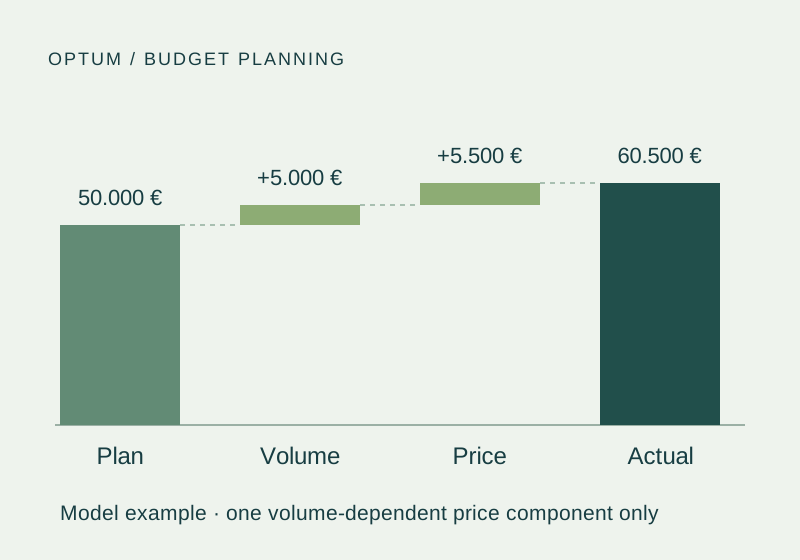
A simplified example considers only one quantity-dependent price component: 500,000 kWh are planned at €0.10/kWh, i.e., €50,000. In reality, 550,000 kWh are billed at €0.11/kWh, i.e., €60,500. The discrepancy is €10,500.
First, the excess consumption is assessed at the planned price. Then, the price change is applied to the actual quantity consumed. This explains both causes without counting any part of the deviation twice. The assumed net prices are used only for this example; other cost items are not included.
Working with three justified quantities
Create a baseline scenario as well as lower and higher consumption assumptions. Justify the range based on your capacity utilization and plant planning. For example, if a large order has not yet been confirmed, plan one scenario with and one without the additional production. This is more helpful for management than a flat surcharge without a clear reason.
For variable price components, you can also use verifiable price assumptions. Do not confuse a risk scenario with a forecast. Document the date, source, and scope of each assumption. A fixed-price contract only locks in what its agreement actually covers.
Another potential cost factor is the need for a short-term re-supply after a delivery interruption. The example calculation regarding supplier risk shows when the additional costs incurred by this can negate the initially lower energy price.
A short, regular budget meeting
Regularly compare planned consumption, current consumption, expected annual consumption, and cost variances. For the annual forecast, add the expected demand for the remaining months to the already measured consumption. For gas, include seasonal heating requirements in this calculation; you can't simply multiply a single winter month by twelve. Assign anomalies to a cause: operational changes, price changes, billing period, or data errors. This will then lead to a specific task with an assigned person responsible.
Plan, actual results and remainder of the year: an annual forecast as of June 30th.
Completely synthetic calculation example, no customer case and no price forecast. Considers an electricity supply point in the calendar year 2026. All prices and costs are net; calculations are based solely on a quantity-dependent price component. Basic prices, capacity prices, and other items are not included.
The original annual plan contains 1,000,000 kWh at €0.10/kWh: 450,000 kWh for January–June and 550,000 kWh for July–December. By 30 June, the model has complete readings and cost data for the first half-year. An additional shift raises the newly planned volume for the rest of the year to 600,000 kWh; an assumed price of €0.12/kWh applies to this period.
| Period and status | Quantity | Price per kWh | Variable costs |
|---|---|---|---|
| January–December · original plan | 1,000,000 kWh | 0.10 € | 100,000 € |
| January–June · Actuals in the model | 480,000 kWh | 0.11 € | 52,800 € |
| July–December · new remainder of the year forecast | 600,000 kWh | 0.12 € | 72,000 € |
| January–December · new annual forecast | 1,080,000 kWh | calculated per half-year | 124,800 € |
Annual forecast = Actual up to the cut-off date + newly expected remainder of the year. Here, that's 480,000 + 600,000 = 1,080,000 kWh and 52,800 + 72,000 = €124,800. Compared to the original plan, the quantity increases by 80,000 kWh (8%) and this cost component by €24,800 (24.8%).
The cost variance can be fully explained: 80,000 additional kWh × €0.10/kWh planned price results in a quantity effect of €8,000. The price effect is 480,000 × (0.11 − 0.10) + 600,000 × (0.12 − 0.10) = €16,800. This totals €24,800. The additional quantity is first valued at the planned price; the price effect is then applied to the actual or forecast quantity for the respective half-year.
The remaining annual requirement is derived from the planned operating months. It is neither automatically the annual planned quantity minus actual consumption, nor simply a doubling of the first half of the year. If measurement or billing data is still incomplete, mark any added quantities and costs as estimates and note the period still awaiting data. For each assumption, agree on a source, a responsible party, and the next review date.
Keep your cost budget and payment plan separate. Advance payments determine when money flows out; they alone don't tell you what costs will be incurred in the planned period. Therefore, a potential additional payment should be included as a separate item in your cash flow plan.
The electricity cost calculator helps with an initial comparison of quantities and prices. For invoice verification, the article Checking your business electricity bill guides you through quantity, price, and time period. Clarify how your procurement framework fits your budget with OPTUM. Bring your quantity assumptions and desired planning horizon. This will help us determine which price components you want to hedge and where further clarification is needed.