
What RLM records for gas
RLM means recorded load measurement. The German Messstellenbetriebsgesetz (Metering Point Operation Act) provides for hourly gas recording for end users to whom simplified standard load profiles do not apply, and for end users with smart metering systems. For the remaining cases, it specifies continuous measurement of gas offtake. This rule alone does not tell you which file format your business will receive. Source: Messstellenbetriebsgesetz, § 58 paragraph 1.
For practical testing, it is worthwhile to separately examine the measurement method, billing period, and data access. A total consumption over twelve months does not replace a time series for individual hours. Conversely, an existing hourly series does not yet answer the question of whether all values were measured or whether individual periods were supplemented with substitute values.
Understanding measurement methods
Where does the consumption time series come from?
Standard load profile → profile-based progression for quantity allocation.
Hourly recording → Time series whose data status needs to be checked.
SLP assignment and measurement are separate issues: Section 58 of the Metering Point Operation Act (MsbG) also stipulates hourly recording for smart metering systems. Therefore, have the actual data volume confirmed. Legal basis: Section 58 MsbG.
Which thresholds have applied since 2026?
The previous Gas Network Access Ordinance expired on December 31, 2025. Therefore, the metering classification should not be based solely on an old reference to this ordinance. Source: Federal Network Agency on the expiry of the Gas Network Access Ordinance.
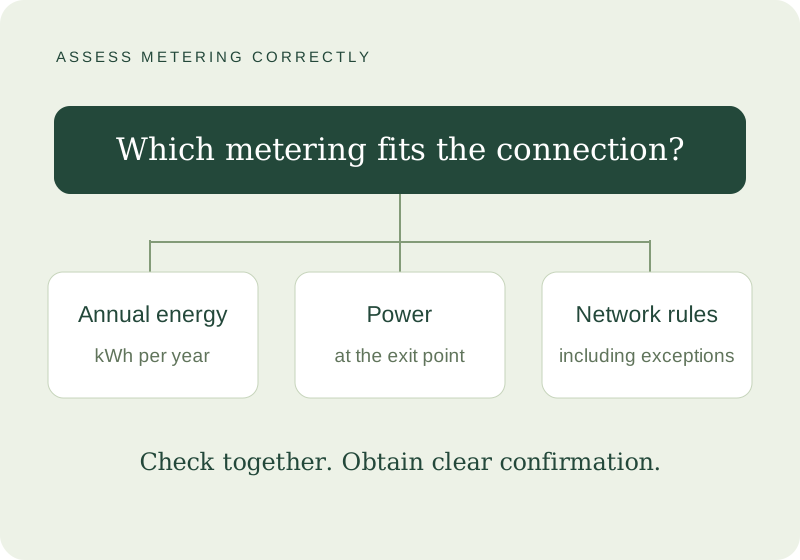
Since 1 January 2026, the GaBi Gas 2.1 determination has applied. Under it, distribution network operators generally use standard load profiles when both limits are met: no more than 1.5 million kWh of annual offtake (one and a half million) and no more than 500 kWh per hour of maximum exit capacity. The latter corresponds to 500 kW. This means the maximum capacity reserved by the network operator at the exit point for the network transport customer; it is not automatically the rated power of an individual heating appliance.
Get confirmation of any different thresholds
The ruling allows higher thresholds. Lower thresholds are possible if reliable network operation could not otherwise be technically ensured, or if individually agreed with the transport customer. Deviations may affect individual load profile groups; uniform thresholds must apply within each group. These figures alone therefore do not impose an unconditional RLM requirement on every business. Have the classification for your business confirmed. Source: Federal Network Agency, GaBi Gas 2.1, operative provisions 1 e, 1 i and 10.
Assignment step by step
Two conditions lead to the correct follow-up question
- If both are complied with: SLP standard case. Otherwise: Clarify RLM assignment.
- Check for different grid-specific thresholds in both cases.
- Have the procedure for the specific exit point confirmed.
500 kWh/h corresponds to 500 kW of available offtake capacity. Lower limits require technical requirements for functioning grid operation or an individual agreement with the transport customer. Uniform limits apply within an affected load profile group. GaBi Gas 2.1, operative provisions 1 e, 1 i and 10.
Clarify the connection assignment
Start with a single location and a clearly identified metering point. Keep the address, existing metering point or market location identifier, meter number, and the period under consideration together. For multiple connections, the documents should initially remain separate. Otherwise, totals from several locations could be mixed with information from a single exit point.
Ask the grid operator to confirm the procedure used, the relevant limits, and the effective date. The maximum available offtake capacity should be explicitly stated. A self-calculated annual average is not suitable for this purpose. In the case of a planned upgrade, the current state and the expected changes should be listed on separate lines.
Measurement and data provision
The metering point operator is responsible for the operation and maintenance of the metering equipment, as well as the processing and transmission of measured values. Therefore, please direct any questions regarding the specific provision of data to them. Source: Metering Point Operation Act, Section 3 Paragraph 2.
A helpful request is: "Please confirm the current measurement procedure for this measuring point and explain which hourly values are available for the specified period. Please also state any outstanding requirements and the responsible contact person."
Practical inquiry sequence
Three roles, one common reference
Clearly name the connection.
Compile: Identifiers, existing documents and planned changes of use.
Result: All parties involved are talking about the same measuring point.
Get confirmation of the metering classification
Follow-up questions: What procedures and limits have applied here since when?
Result: Documented assignment with reference date.
Clarify measurement values and export
Questions: What values are available, how are they provided and explained?
Result: Available time period, export description and open data questions.
Recommended workflow, no commitment to a specific response format or free services. Tasks of the metering point operator: § 3 paragraph 2 MsbG.
You should request this data.
The following list is a practical working template. It describes useful information for the evaluation, not a blanket promise of free data access or a specific export format.
| Document or information | Specific question |
|---|---|
| Original export with time period and measuring point identifier | Do all lines belong to the confirmed connection and time period? |
| Unit and meaning of each value column | Are these kWh per hour, average kW, or cubic meters? |
| Timestamp and time zone | Does the timestamp indicate the beginning or the end of the interval? |
| Data quality indicator | How are measured values, substitute values, and missing data identified in this file? |
| Changes in the measurement setup | Was there a meter change or a change in procedure? |
| Explanation of conversions already carried out | What quantities have already been converted, and which factors apply to the time period? |
Move the table sideways if needed →
Request the legend that belongs to the file. Abbreviations or status numbers should be read using this documentation; an unknown identifier is not reliable evidence for a measured value.
Read one line correctly
Only four pieces of information yield an understandable value.
Reading example: Beginning of a full hour.
Check: Date, time zone, interval start or end?
Reading example: Energy within this hour.
Check: Energy, average power or volume?
Reading example: 240 kWh in one hour.
Check: Decimal separator and number format read correctly?
Reading example: Meaning from the file legend.
Check: Measured value, substitute value, or missing value?
Synthetic reading example without customer data. The four cards do not represent a prescribed file format; names and status codes depend on the export and its legend.
Check units, time reference, and data status
Gas volume and energy are different quantities. When converting a volume measured under operating conditions into energy, the volume conversion factor and gross calorific value play a role. Therefore, check whether the file contains operating volume, already converted standard volume, or energy. kWh values already shown must not be converted again using these factors. Our gas converter from m³ to kWh explains the basics. Technical source: DVGW on thermal gas billing.
A purely theoretical example: 240 kWh within a full hour corresponds to an average power of 240 kW. This does not reveal any short-term peak within that hour. This example is synthetic and does not describe actual customer consumption.
Show missing values
Furthermore, clarify whether daily reports summarize calendar days or gas days and how time changes are handled. Initially, mark missing or duplicate timestamps as checkpoints. An empty cell does not prove zero consumption. Likewise, a substitute value should remain identifiable for later interpretation. Further checks are described in the article Checking Load Profile Data.
Record the result for further work
Keep the original export and work with a copy for corrections. A brief overview should show: assignment confirmed or open, time period complete or limited, units clarified or unclear, next question and responsible person. This keeps clear what conclusions the data already supports.
A suitable hourly time series can then be used to prepare the load profile analysis. Hasan and the energy team can help you structure the documents and address any open questions. Procurement decisions are a separate step; the article on commercial gas procurement describes the necessary basis for the bids.
Frequently Asked Questions
Is a digital gas meter automatically an RLM (Recorded load measurement) meter?
The digital display alone does not prove the method used or the availability of an hourly export. Have the measurement method, data scope, and delivery method explicitly confirmed.
Is the annual quantity sufficient for assessment?
No. In addition to the annual quantity, the threshold rule also takes into account the maximum offtake capacity and possible deviations. The confirmation must match the specific connection.
How can a smaller business request hourly consumption data?
Ask the network operator, metering point operator, and supplier together about the possible procedure. Clarify the technical requirements, approval requirements, costs, and conversion date before planning the evaluation.
Is it possible to generate a missing hourly log from the annual statement?
An annual volume distributed by calculation remains an assumption. It must not be used as a measured trend to prove actual operating times or peak loads.