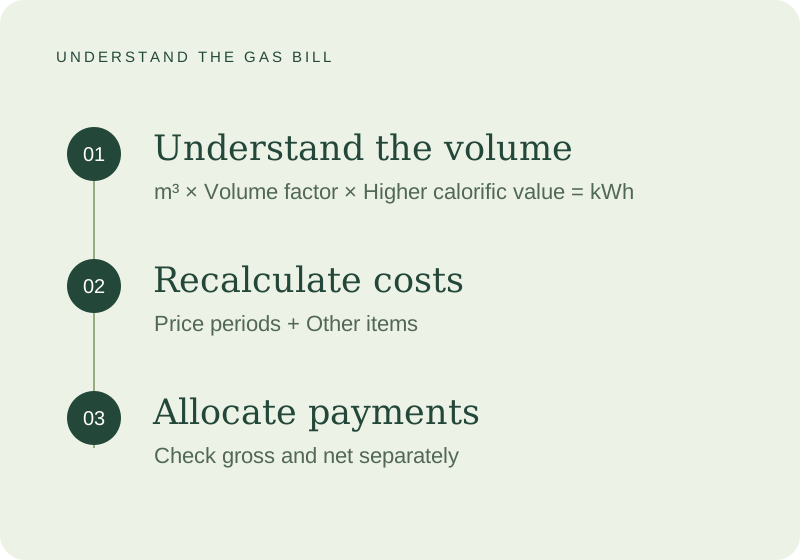
First assign, then calculate
Place your current bill, previous billing statement, contract including price lists and amendments, and your meter reading and payment receipts side by side. If you have multiple locations, each supply point will be reviewed separately. A central office can have multiple customer numbers; the same postal address does not necessarily mean the same gas connection.
Compare the consumption point, market location ID, and meter number. Then check whether the initial reading matches the previous final reading. A meter change requires the assignment of both devices and their respective readings. Also note whether an invoice replaces a previous one or only supplements it. Otherwise, the same charge could easily appear twice in the internal overview.
The legally required billing information includes, among other things, the point of consumption, prices, initial and final meter readings, and the determined consumption. End consumers can request an explanation of an unclear bill free of charge. Legal basis: Section 40 of the German Energy Industry Act (EnWG).
Every question requires evidence.
- Delivery point: Compare invoice with contract and connection identifier.
- Quantity: Use reading slips and measurement data.
- Price: Combine quantity and price list for the same period.
- Payment: Reconcile recorded advance payments with payment receipts.
An unresolved step remains open. Only after the allocation can the amounts be meaningfully compared.
Measurement values: Read, replaced, or estimated?
A plausible total does not prove that the underlying values are correct. The invoice must clearly show how the meter reading was determined. Substitute values and estimates are to be treated differently; an estimate is permissible under certain conditions and must be identified by its basis and calculation factors. Legal basis: Section 40a of the German Energy Industry Act (EnWG).
For your own review, the cut-off date is crucial. A photo taken today does not directly refute an invoice reading from four weeks ago. Therefore, for each value, record the date, meter number, unit, and source. In case of a significant discrepancy, request an explanation instead of retroactively using a current reading without verification.
In a business, actual changes can also be helpful: Was an additional furnace in operation? Were there longer opening hours, an extension, or reduced production? This information explains possible changes in consumption. It doesn't replace measured values, but it makes inquiries much more specific.
Compare the energy quantity; do not convert it twice.
First, check the unit and the register. If the gas meter shows operating volume in m³, the volume conversion factor and the billing gross calorific value are used for conversion to kWh. If standard volumes or energy quantities are already included in your data, you must not treat them again as operating volumes. The factors must belong to the respective billing period; a general factor of ten is not sufficient. Explanation from the Federal Network Agency.
The actual calculation method, including gross calorific value, volume conversion factor, and both conversion directions, can be found in the gas converter for m³ and kWh. Enter the values from your bill there and compare the result with the billed quantity. If the factors differ, recalculate the sections separately.
A matching kWh quantity only confirms this verification step. Whether the invoice amount is correct also depends on the prices, time periods, other items, and payments taken into account. This is precisely the verification that follows.
Quantity is correct – invoice not yet fully checked
Delivery point assigned · Energy quantity compared
Identifiers and measured values are traceable.
Price periods · Payments
The quantity allocation and recorded advance payments still need to be reconciled.
Illustrative review status, no customer invoice. A confirmed energy quantity does not yet explain the invoiced price or the remaining balance. Open issues remain visible until clarified.
Price changes require appropriate quantities
If a price was changed during the billing period, the calculation "annual quantity times last price" is insufficient. Assign the corresponding quantity billed to each price period. Have it explained to you how the quantities were determined at the transition point. Especially with seasonal heating, simply distributing the annual quantity over twelve equal months is not a reliable substitute for the actual billing method.
Own calculation model, not a customer invoice: An assumed annual quantity of 211,200 kWh is distributed across two price periods. The quantities are model assumptions; the prices are neither current market values nor an OPTUM offer.
| Model item | calculation | Net costs |
|---|---|---|
| Price period A | 90,000 kWh × €0.060/kWh | 5,400.00 € |
| Price period B | 121,200 kWh × €0.064/kWh | 7,756.80 € |
| Fixed annual item | assumed total amount | 480.00 € |
| Total model costs | Total of the three items | 13,636.80 € |
Move the table sideways if needed →
For this simplified model, the energy prices, including all consumption-dependent net components, and the fixed item are considered complete. A real contract may be structured differently. The table shows neither VAT nor advance payments and therefore no amount due.
The crucial control question is: Are the listed individual components already included in the agreed price or are they charged separately? Do not add the same line of information twice. Also check whether monthly or annual prices for a partial period have been correctly prorated.
Two price periods, different cost shares
90,000 kWh
at 0.060 €/kWh
5,400.00 €
121,200 kWh
at 0.064 €/kWh
7,756.80 €
Assumed annual amount
without quantity-dependent calculation
480.00 €
A + B + F = €13,636.80 net
The bar widths show cost shares, not time periods. B is larger because both the quantity and the model price are higher. All values are synthetic; the energy unit prices include all net variable components. No market rate, no OPTUM offer, and no payment due.
For delivery periods from 1 January 2026 onwards: please note the gas storage levy.
When the changeover takes place on January 1, 2026, the pass-through of the relief must be examined separately. Insofar as the previous levy was passed on to customers, Section 35g Paragraph 7 of the German Energy Industry Act (EnWG) obliges the suppliers covered therein to reduce prices accordingly and to provide transparent information on the invoice. Proof that the levy was not included in the calculation, or not fully included, may be relevant in this context. Legal basis: Section 35g Paragraph 7 EnWG.
Do not simply copy an unchanged list of levies from an old bill. For a period spanning the turn of the year, specifically ask how charges are treated before and from 1 January 2026. Removing one component does not mean the total bill falls: consumption, other components and pricing periods still need to be checked.
Advance payments explain the additional payment – not the consumption
The total cost and the remaining balance are two different things. Reconcile the payments shown on the invoice with your accounting records: amount, payment date, purpose, and assigned delivery location. Keep gross and net values separate. A gross advance payment cannot be directly subtracted from a net cost total.
A subsequent payment may be required despite correct pricing if the advance payments were too low. Conversely, a credit balance can mask high consumption. Therefore, for your next planning, you will need both the verified costs and the payment overview. How the balance is calculated in standard load profile (SLP) billing and the role of RLM in this process is explained in Advance Payments and Subsequent Payments in Business. For further annual planning, the article on Energy Budget in Business supplements this review.
The same costs can result in a remaining balance or credit.
Gross total costs
of the audited billing period
Recorded gross advance payments
for the same delivery point and the same period
Calculated balance
Costs less any payments taken into account
Balance > 0
Remaining amount
The payments made so far do not fully cover the costs.
Balance = 0
Balanced
The payments taken into account equal the costs.
Balance < 0
Credit
More was paid than was charged for this period.
Simplified balance calculation without additional amounts: Both sides must have the same VAT base. Therefore, the net amount from the previous model cannot be directly offset against gross advance payments. The complete invoice with all entries and the due date stated therein remain decisive.
A follow-up question that can be answered
Our recommendation for a clear and objective clarification: Always specify the invoice, item, period, and your supporting document. A useful formulation is, for example:
Please explain the allocation of quantities between the two price periods in invoice [number] for market location [ID]. The invoice lists [Quantity A] and [Quantity B]. Our dated meter readings are attached. Please inform us which measurements or calculation factors the allocation is based on and check whether a correction is necessary.
Relate the answer back to the specific item. "Invoice checked" is insufficient as an internal note as long as quantities or pricing information remain unclear. A technical inquiry does not automatically determine whether payment is deferred or legal objections are raised; such issues must be clarified separately based on the contract and the specific circumstances of the case.
Frequently asked questions about commercial gas bills
Does a high balance payment prove that the natural gas price is wrong?
No. Check consumption, volume-to-energy conversion, billed prices and payments separately. Only this breakdown shows how the remaining balance arose.
Where do I calculate an unusual gas quantity?
Use the gas converter with the factors from your bill . If the input and result match the bill, next check the price sections and payments. The calculator alone does not confirm a complete bill.
Is a photo of the first page of the invoice sufficient for the audit?
The calculation steps are usually missing. For a reliable professional review, the invoice and supporting documents should be complete, supplemented by the contract, price changes, and relevant meter readings.
What is particularly important when there are multiple locations?
Each invoice must be assigned to a unique delivery point. Only then can results be evaluated together. The same industries or similar buildings do not necessarily imply identical gas consumption.
How does OPTUM support the assessment process?
Hasan Sahin and his team will analyze quantities, price components, and outstanding issues based on your complete documentation. The goal is to provide a concrete basis for your next decision: What is transparent, what needs clarification, and what does this mean for your future procurement? Discuss commercial gas with OPTUM.