
If the supply must be secured first
The current contract is ending. New offers are much more expensive. Some suppliers issue offers only to a limited extent or apply stricter credit checks. In this situation, a business is not seeking a theoretically perfect purchasing moment. It needs a solution that can provide supply and remains financially manageable.
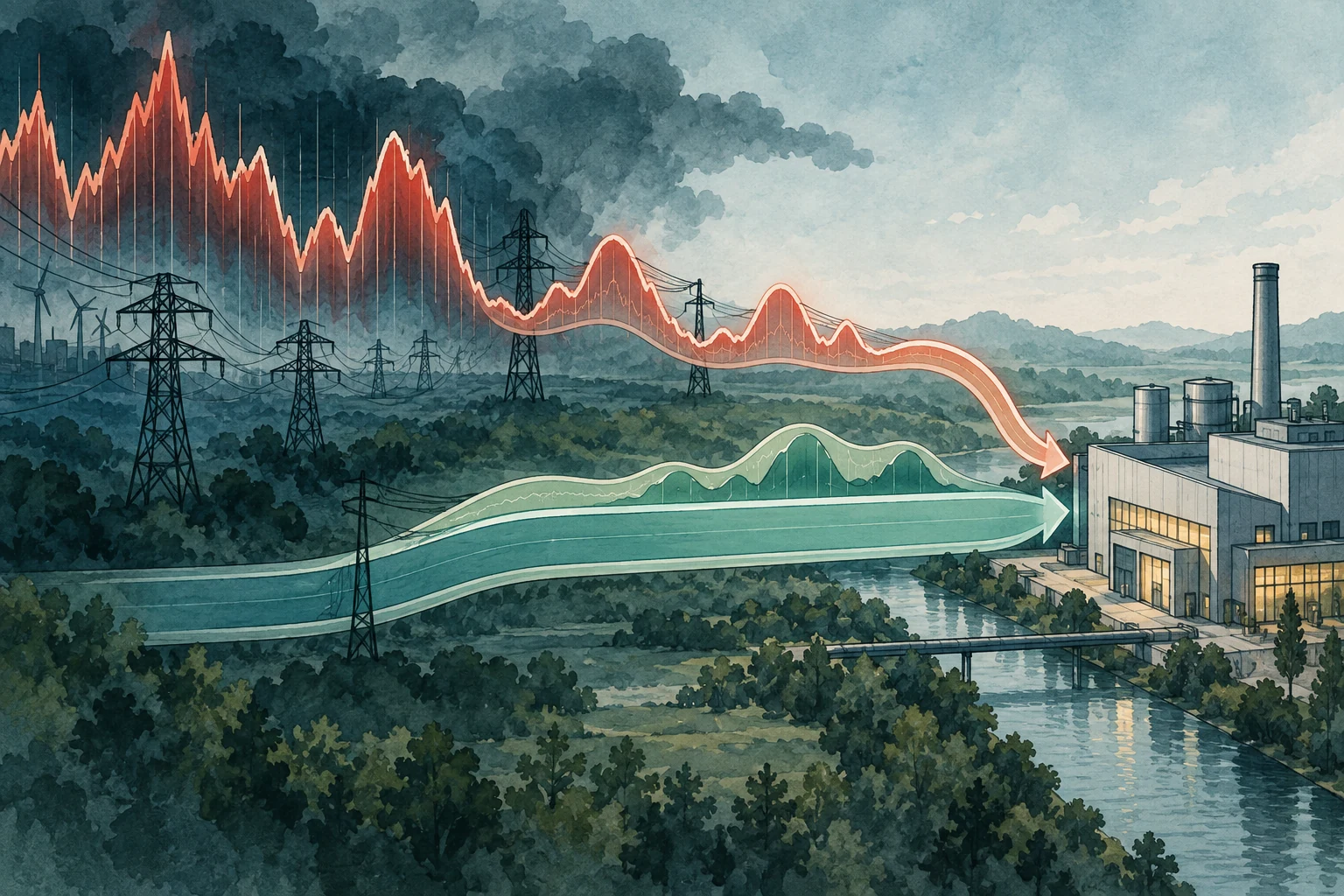
While a long-term fixed price can provide planning security, it can also lock in a high price level for years. A spot or index model allows future market developments to play a greater role in billing. This opens up the possibility of participating in falling prices – and exposes the business to further increases. A hybrid model distributes demand across both approaches.
A look back at OPTUM consulting
Personal experience report, editorially contextualized: Hasan Sahin recalls companies that only came to OPTUM after the sharp price increases. Favorable long-term conditions were no longer attainable for these businesses at that time. In some cases, the initial challenge was simply obtaining a suitable supply offer.
As he recalls, OPTUM also used spot and index models for new electricity and gas customers in 2023. The idea was not that energy had suddenly become cheap during the high-price phase. Rather, the aim was to enable businesses to participate more quickly in later market easing, instead of fixing the previous price level completely in the long term.
Some solutions combined fixed and variable quantity components. Hasan cites a smaller fixed component of around 20 to 30 percent as an example. Especially with clients who feared further increases, the consultants had to carefully explain which exposure remained. Such a structure is not a one-size-fits-all solution: it must be tailored to the product offered and the company's financial capacity.
In contrast, previously agreed-upon, longer-term fixed prices were able to keep the hedged energy component stable during later price spikes. These contracts also eventually expire. For follow-on procurement, the then-current market environment becomes relevant again. Early hedging postpones and limits certain risks; it does not permanently eliminate price fluctuations.
This practical account is based on Hasan's recollection. It is not a verified individual customer invoice. Without comparable contract and invoice documentation, we will not disclose customer counts, specific savings, or damage amounts.
Fixed price, spot/index and hybrid: What you actually agree on
A fixed price for a defined need
The agreed energy price applies to the specified delivery period and the consumption covered by the contract. The scope of the price guarantee, the quantity band, and adjustment clauses determine how much is actually predictable.
- chance
- Greater budget stability in rising markets.
- risk
- Subsequent market declines usually do not have an immediate impact on tied-up quantities.
- Check
- Excess and shortfall quantities, profile costs, duration and separate price components.
A price follows an agreed reference.
The energy component is calculated based on the contractually specified market index and other agreed-upon costs. The reference market, time intervals, weighting, and billing formula are crucial.
- chance
- Falling reference prices can provide relief in the short term.
- risk
- Rising prices can quickly strain the budget and liquidity.
- Check
- Index, markups, minimum prices, billing frequency and collateral.
Combine fixed-price and unpriced volumes deliberately
Part of the demand is price-hedged, while the remainder is market-based. Depending on the contract, allocation can be based on quantities, time periods, or a load profile.
- chance
- Part of it can be planned, another part participates in market developments.
- risk
- Unhedged quantities remain expensive when the market rises. An unsuitable quantity structure creates additional risks.
- Check
- What exactly the percentages mean and how deviations are settled.
An energy exchange price is not the complete delivery price. Supplier markups, service charges, balancing, quantity and profile deviations, as well as network charges, taxes, and levies may be added. Negative energy exchange prices therefore do not automatically mean that the entire energy bill will be negative. Our guides for commercial electricity bills and commercial gas offers show which components you should compare.
Fixing 25 percent does not make 25 percent risk-free
One quarter is fixed in price, three quarters are market-based. This is a calculation model, not a recommendation for your business.
Before a contract is signed, it must be clarified: Does it refer to 25 percent of the expected annual volume? A consistent band across every hour? Or a portion of each billing interval? These variations can lead to different results despite using the same percentage.
A business using electricity on changing shifts and a gas-heated building with strong winter demand do not consume uniformly. The remaining unhedged demand may be high precisely when market prices are high. The load profile therefore belongs in the assessment. For gas, temperature dependence and the contractual gas price reference also matter. The balancing energy prices published by Trading Hub Europe relate to balancing; they are not automatically the spot index agreed in your supply contract.
Related to this: Classifying quantity and profile risks in the supply contract →.
Three directions. Three different results.
The following example shows only the energy component . It assumes 1,000,000 kWh, a fixed price of 10 ct/kWh, and a fixed hybrid share of 25 percent. The respective spot price is a fictitious, already consumption-weighted period price. All three models are compared for the same quantity and the same period.
This is a schematic sensitivity calculation, not based on current offers or forecasts. Markups, profile and quantity deviations, network costs, duties, and taxes are not included. These must be added for a genuine comparison; the amount of the offered fixed price is also unknown.
What the historical market trend explains
Sharp price declines are possible after a period of high prices. According to the Federal Network Agency/SMARD, the average day-ahead electricity price in August 2022 was €465.18/MWh. From October onwards, the monthly averages decreased again. The annual average for 2022 was €235.45/MWh. These different reference periods should not be confused. Source: SMARD, 2022 Review.
In retrospect, such a trend explains why an open price component could later provide relief. It does not prove that the peak was foreseeable at the time of the decision. Likewise, a market average does not automatically correspond to the price of a company with its specific consumption profile.
High volatility can also increase suppliers' financing needs, for example, through collateral for trading positions. The ECB describes these liquidity risks for the energy markets in 2022. Therefore, the resilience of the contractual partner remains relevant in all three models. Further background information is provided in Energy Prices and Supplier Risk.
Related: Initial Margin and Variation Margin explained in an easy-to-understand way →.
Seven questions before the decision
How much predictability is necessary for the business?
Check how binding sales prices and margins already are. A high variable energy component is difficult to reconcile with fixed customer prices if the business cannot absorb cost jumps.
What level of burden can the liquidity allow?
Calculate using an unfavorable price scenario and consider individual months. A manageable annual average is of little help if a high winter bill jeopardizes your ability to pay. Advance payments, collateral, and additional payments are all part of the equation.
How reliable are the quantity and load profile?
Use complete consumption data and realistic production assumptions. New shifts, shutdowns, self-supply, and location changes will alter the remaining demand.
What data and support are available?
A variable contract requires clear billing and a coordinated monitoring schedule. Responsibilities, reporting procedures, and response options must be clarified in advance.
What binding agreements and switching options apply?
Spot pricing does not automatically mean a short contract term. Check notice periods, conversion options to fixed-price components, and the applicable prices or fees.
Is the structure even available to the business?
Suppliers may require minimum quantities, specific measurement data, and creditworthiness. A product that exists on the energy exchange does not automatically translate into a suitable supply contract.
How reliable is the supplier?
In addition to price, evaluate the contract terms, procurement structure, communication, and financial viability, insofar as information is available. The Supplier and Procurement Review explains these levels.
A business spot contract is different from statutory fallback supply
This concerns deliberately agreed-upon supply contracts for businesses. Statutory basic or substitute supply in the event of a supply problem, dynamic household electricity tariffs, and direct trading on the energy exchange are separate matters. The terms of a commercial contract cannot simply be derived from their pricing or legal framework.
With a spot or hybrid supply contract, the supplier remains your contractual partner for the agreed delivery. Who bears which market, volume, balancing, and default risks is determined by the specific agreement. A clear overview of the terms can be found under Understanding Procurement Models.
Acting early creates more options
The crucial lesson of this crisis is not "always fixed price" or "always spot price." Knowing consumption, contract end dates, and financial flexibility early on gives you more time to evaluate offers and suitable structures. Acting late can significantly limit your available options.
OPTUM Pro and the personal assessment of our team support the processing of information and the preparation of such decisions. We review the data together with your company and discuss under what conditions a new audit makes sense. The future remains open; the decision-making process can be carefully planned.